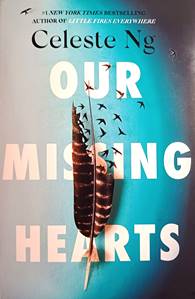
This is a political novel embedded in a story of love between a mother and her son, placed in the context of resistance to an authoritarian regime. This regime is a fictionalized United States of America whose people are under strict surveillance based on the “Preserving American Culture and Traditions Act (PACT).” The core enemy is China. This act has three pillars:
“Outlaws promotion of un-American values and behavior.
Requires all citizens to report potential threats to our society.
Protects children from environments espousing harmful views.” (p. 21)
The third pillar enables the authorities forcefully to remove children from families suspected of sympathies for China, while the first pillar includes the power and practice of removing books suspected of endangering “national security” from public libraries.
In roughly the first half of the book, the story is told through the struggle of Bird, a twelve-year-old boy. His mother, Margaret Miu, a Chinese American poet, had left him with his white American father three years prior to prevent Bird from being taken from his parents and sent to live with foster parents. In a protest against the PACT regime, a line from one of her poems—“Bring back our missing hearts”—had been used as the rallying cry. Thus, Bird’s mother was suspected of being a sympathizer. The boy’s best friend, Sadie, in fact, was living in a foster family after having been removed from her parents.
Three years after her disappearance, Bird receives a letter from his mother, though without a sender’s address, and without any written message. Instead, the envelope contains a piece of paper with drawings of all sorts of cats. Bird wonders about the meaning of all these drawings of cats. Eventually, with the help of a sympathetic librarian, he finds the book, The Boy Who Drew Cats: A Japanese Folktale. “A Japanese folktale, but his Chinese mother had heard it or read it somewhere, had remembered it and told it to him. … It’s coming back to him, the way his mother told it…” (p. 73). All the while, his father, moved down from being a professor to working in a library, tries to stop his son from pursuing his search any further, knowing that they are under surveillance by the PACT authorities.
One day, Bird visits their unoccupied former house, in which the family had lived together before his mother disappeared. He looks around and finally comes to his old room. In it, there is a panel that actually is a door. This used to be his secret hiding place when he was still a small child. It was like a cave for him. Now, he can hardly manage to squeeze himself in. But he finds a scrap of paper. In the handwriting of his mother, the text says: “DUCHESS, New York City, Park Avenue.” This is on page 104. As it turns out much later in the book, Bird had found the contact address of the person who could take him to his mother. Meanwhile, his visits to the library reveal the existence of a clandestine network aiming at discovering where displaced children had been sent: “All our missing hearts, scattered, to sprout elsewhere” (p. 112).
On p. 121, Bird leaves a brief note for his father, saying that he is off to New York and that he will be back in a few days. “Don’t worry.” After his arrival in New York, he goes to the address found on the scrap of paper. After undergoing a test to show whether he is who he claims to be, he is sent to the backdoor of a neglected house, where he must key in a code for it to open. Footsteps: “His mother, astonished. Holding out her arms. Throwing them around him. Her warmth. Her scent. The shock and wonder and delight on her face. Bird, she cries. Oh Bird. You found me.”
This happens on p. 142. The remaining pages until the end on p. 325 switch to tell her story of the past three years from her perspective, by way of explaining the situation to her son. But the grand finale for which his mother had tirelessly worked for the past almost three years by identifying disappeared children and talking to their grieving parents still has not taken place. When Bird is picked up by the Duchess in preparation of Margret Miu’s great finale, she says,
“Bird. Why did I tell you so many stories? Because I wanted the world to make sense to you. I wanted to make sense of the world, for you. I wanted the world to make sense.
…
But in the end every story I want to tell you is the same. Once upon a time, there was a boy. Once upon a time there was a mother. Once upon a time, there was a boy, and his mother loved him very much.” (p. 301f.)
There is a triumphal ending to her efforts, but it is not a happy one.
See also the notes on her earlier book at
MHN
Nonthaburi/Thailand
7 December 2023
 Books worth reading
Leave a comment