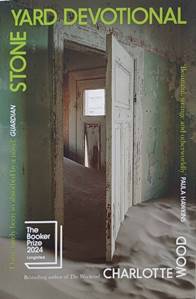
Some time ago I read the author’s The Weekend (see my related note). Since I was less than impressed by that text, I did not expect to read another of her novels until the Booker Prize committee not only longlisted her Stone Yard Devotional, but also shortlisted it in 2024. In this novel, an unnamed female first-person narrator describes her everyday life in a small isolated Catholic convent in Australia. At first, she spent a few days there several times, before she decided to live there for good. On page 283, she recounts how her dying mother’s doctor—the author alternates stories about the protagonist’s life in the convent with events from her earlier life, including a running self-conversation with her mother—prescribed her a tranquillizer. She adds, “Thinking of this now, I find it remarkable that I never took any of the pills myself.” In fact, her life in the convent seems to be an exercise in self-tranquillization. She wanted to leave the rat race in which she was involved for a quiet and peaceful alternative.
Even in such a place, however, the world cannot be kept out entirely, either physically (some food and other items have to be bought in the town shops) or in terms of one’s memories, regrets or unfulfilled opportunities for forgiveness. Much of the book is then taken up by two intrusions. One is a severe plague of mice. I could not help feeling that the mice played a similar role to that of the dog, Finn, in the earlier novel. Without the mice, as with Finn, many pages would have remained blank. The second is the intrusion of a famous activist nun called Helen Parry. She used to be in the same class at school as the narrator, who got together with her schoolmates to give her a beating, and she is still very embarrassed about her behaviour at the time. Helen will be visiting the convent to return the remains of Sister Jenny to the place where she used to live, to give her a proper burial. She had disappeared, probably murdered, many years ago while doing social work in Bangkok. But her remains had only recently been found. The sisters and the narrator are not looking forward to Helen spending time with them. But they are glad that Sister Jenny is finally being laid to rest as she should be.
Since the novel is about everyday life in a tiny mostly quiet and peaceful Catholic convent, it will come as no surprise that the narrative flows leisurely through the pages like a small shallow stream in the countryside. Obviously, Charlotte Wood wanted her text to reflect the routine boredom of the slow-paced lives of people who have decided that what they need is peace, quiet, and prayer rather than the hustle and bustle of a modern lifestyle.
MHN
Nonthaburi, Thailand
7 October 2024
 Books worth reading
Leave a comment