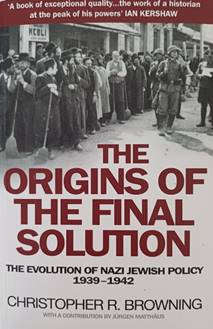
When Nazi Germany started its war by invading Poland in September 1939, the Holocaust of European Jews did not yet exist as a unified murderous policy approach. Rather, the content of this policy and its administrative and technical implementation were gradually devised in the two years after this invasion in reaction to the changed context of the Nazis’ policy-making process. Therefore, the core of this book is dedicated to the period from September 1939 through to March 1942. The infamous “Wannsee Conference” about the “Final Solution” (Die Endlösung der Judenfrage) took place on 20 January 1942 (for the German original, see https://www.ghwk.de/fileadmin/Redaktion/PDF/Konferenz/protokoll-januar1942_barrierefrei.pdf, an English-language translation is at https://www.ghwk.de/fileadmin/Redaktion/PDF/Konferenz/texte/English_translation_wannsee_protocol_2020.pdf ).
During the initial phase of the war, the “Jewish Question” was supposed to be solved through various ideas concerning deportations. This included the “Madagascar Plan,” according to which four to six million European Jews were envisaged to be sent to that island, implying that they would die there of starvation. Meanwhile, however, the occupation of Poland presented the Nazis with the urgent question of how to handle the Jewish population in that country, especially those living in big cities, such as Warsaw or Lodz. In reaction, the Germans turned to the means of forced Ghettoization. This led to a follow-up question, namely what the purpose of these Ghettos was to be. Should they serve to exploit the labor of the imprisoned Jews to support the German war economy or should the Ghettos serve the purpose of mass murder by means of overpopulation, lack of sanitation, food, and health care? Such questions were vigorously debated among policymakers and the managers of the Ghettos.
In the meantime, the persecution of Germany’s Jews intensified between 1939 and 1941. While a policy of forced emigration had been pursued since after the pogroms of November 1938, this option, as well as the Madagascar Plan, became increasingly less viable after Germany started the war. “On October 17, 1939, … Hitler met with Keitel and emphasized that Reich territory was to be cleared of ‘Jews, Polacks, and riffraff,’” the latter including “Gypsies” (p. 181). During the same period, the killing of the handicapped (“euthanasia”) was increasingly pursued. With the war against Poland, Polish handicapped became “an additional group of undesired Poles that fell victim to the mass killings that engulfed West Prussia in the fall of 1939” (p. 186). In the forest of Szpegawski, some 7,000 victims were shot and buried; in the Piasnitzer forest near Gdynia, the number of killed was about 10,000 (p. 187).
A turning point in the Nazi’s view of how to handle the Jewish population was reached with the attack on Russia (“Unternehmen Barbarossa”) on 22 June 1941.
From the beginning, Germany adopted a policy of terror that, though foreshadowed in earlier plans for this was of destruction, gathered momentum over time. Already by the end of 1941, the death toll among noncombatants was devastating: Between 500,000 and 800,000 Jews, including women and children, had been murdered—on average 2,700 to 4,200 per day—and entire regions were reported ‘free of Jews.’ While many Jewish communities, especially in rural areas, were targeted later, the murder of Soviet POWS reached its climax in this early period. In the fall of 1941, Red Army soldiers were dying in German camps at a rate of 6,000 per day; by the spring of 1942, more than 2 million of the 3.5 million Soviet soldiers captured by the Wehrmacht had perished. (p. 244)
At the same time, the Nazis also considered the fate of the Jewish populations in the European territories occupied by the Wehrmacht. Eichmann’s Gestapo Office for Jewish Affairs was expanded, and Heydrich obtained Göring’s approval to work out the “Gesamtlösung der Judenfrage” (total solution of the Jewish question). Part of this was the “Endlösung der Judenfrage” (final solution of the Jewish question). This extension of Heydrich’s scope of tasks built on a previous order issued on 24 January 1939. Göring’s approval, which was signed on 31 July 1941, was an important step on the path to the “Wannsee Konferenz” in January 1942. However, it did not yet include systematic mass murder, and one could ask whether Heydrich still thought in terms of mass deportation, or, at this point already, had moved the policy frame in a way that included the mass extermination of all Jews.
These pathfinders to the Final Solution, these inventors of a bureaucratically organized assembly-line mass murder, groped their way along a trail filled with contingencies and uncertainties. These uncertainties, however, must not disguise the fact that the perpetrators sensed what was expected of them and what they were looking for. The extermination camp was not an accident. It did not result from some mysterious process of spontaneous generation. It was a horrific monument to the perpetrators’ problem-solving abilities, but they needed lead time to invent and construct it. (p. 316)
As mentioned above, this invention was preceded by mass shootings of victims. This not only needed many people to carry out the shootings. It also placed a heavy “psychological burden on the killers” (p. 353). After all, shooting, day-in-day-out, men, women, and children was not something that had existed as part of those killers’ given mind sets. Those were ordinary people with usually ordinary minds regarding murder, and many of them had themselves wives and children in Germany. To the Nazis, it was also problematic that the killings were done almost in the open. Knowledge of these actions spread widely among soldiers at the front and families at home. “By October [1941] Nazi innovators had conceptualized one potential, though as yet untried, solution to their problems: the Vernichtungslager or extermination camp” (p. 353; original italics). Concentration camps as such, though, had existed in Nazi Germany almost from the beginning of their rule, and the use of gas vans had already existed too.
Using Zyklon B poison was tested in Auschwitz in late summer 1941. More extensive testing was carried out in the Auschwitz Stammlager in September 1941. In “the fall of 1941, Jews no longer capable of work were regularly selected and sent to their deaths in Auschwitz” (p. 357). In October, the design of the crematoria was revised in talks with the contractor, Topf & Sons, to deal with the increased workload. By the last week of October 1941, the alternative policy options of letting the Jews live or to kill them all was resolved with a decision to the latter.
At the end of their book, the author asks, “What was Hitler’s role in this fateful decision?” (p. 424). He points to Hitler’s “obsession with the Jewish question,” and the impact this had in the Nazi-style political system. “No leading Nazi could prosper who did not appear to take the Jewish question as seriously as Hitler did himself. Thus, Hitler, simply by his existence, exerted a continuing pressure on the political system, which induced a competition among the faithful and ambitious to advance ever more radical proposals and to carry out Jewish policy in an ever more brutal and comprehensive manner … The commitment to some kind of final solution permeated the entire regime, and acceptance of such a priority on the part of the regime characterized much of the German population at large” (p. 425). Moreover, from September 1939 to October 1941, Hitler was also “an active and continuing participant in the decision-making process. Indeed, not a single significant change in the Nazi Jewish policy occurred without his intervention and approval” (ibid.).
MHN
Nonthaburi/Thailand 22 November 2023
 Books worth reading
Leave a comment