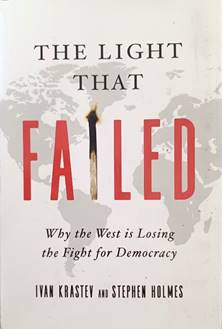
While some important West-European countries have for some time now trying to stave off challenges from right-wing populists (France, Germany, with Italy already having a “post-Fascist” prime minister), this text returns to the post-Cold War period and its political repercussions. The three chapters of the book are about East-Central Europe, Russia, and the USA. The third chapter is especially pertinent because at the time of writing this summary (November 2023), it looks as if Donald Trump will run for president again, with a real possibility of beating Joe Biden. The authors’ treatment of Trump’s electoral basis aligns well with another summary in this series, Angus Deaton, Economics in America: An Immigrant Economist Explores the Land of Inequality. Princeton University Press, 2023.
Krastev, an important public intellectual in Eastern Europe, and Holmes, an academic expert on and proponent of liberalism, acknowledge that, “Most of us have trouble imagining a future, even in the West, that remains securely democratic and liberal” (p. 1).
East-Central Europe
As for East-Central Europe, the “political elites in the region were almost universally enthusiastic about the imitation of Western European and American ‘normality.’” Yet, with the passing of time, arose “hostility to imitating the West,” which became a “key theme of the populist revolt” (all on p. 45). One must also keep in mind that, after 1989, the Western-European model of liberal democracy (and its practice) did not remain static, making an imitation approach a constant process of trying to catch up. Moreover, putting the words “liberal” and “democracy” together is problematic since liberalism is a universalist political ideology, while democracy can only be realized in the context of a national political system (p. 58). As a result, “While the liberal elites continued talking the language of universal rights, their nationalist counterparts eventually took control of the national symbols and national narratives” (p. 57).
All this is not exactly what many observers had anticipated when the Cold War ended. There was high “hopes for liberal capitalist democracy spreading globally” (p. 1). In retrospect, these observers “prematurely celebrated the integration of the East into the West” (ibid.). Krastev and Holmes admit, “The illusion that the end of the Cold War was the beginning of an Age of Liberalism and Democracy was our illusion too” (p. 3).
To a good extent, this illusion resulted from the fact that, after the breakdown of Marxism-Leninism, only liberal democracy seemed to be a viable model for organizing a political order. And since there were countries in the West that had realized this model in the decades prior already, the task of the newly emerging countries of the East simply seemed to imitate that model. This lack of other options, the authors think, “best explains the anti-Western ethos dominating post-communist societies today,” and not an intrinsic preference for authoritarianism nor any historically determined rejection of liberalism (p. 5). It was the wholesale imitation of the Western model required of them, rather than merely a selective borrowing, that eventually turned the elites and their followers against the West. This is so because such borrowing “does not affect identity,” only tools or means, but not “moral ends” (p. 8f.).Importantly, the national elites could argue that elections had become meaningless because the EU would enforce policy continuity. This “allowed aspiring populists to claim exclusive ownership of national traditions and national identity” (p. 22).
At the same time, the national constructs came under threat through the decisions of the younger generations. Impatient with the slow pace of political reforms and economic development, and enjoying freedom of movement within the EU, many of them migrated to those countries where they saw better opportunities to pursue their personal goals. In turn, however, this awakened “fears of national disappearance” (p. 38). Krastev and Holmes liken this to the situation after World War II when the Soviet-supported German Democratic Republic faced massive out-migration to the Western part of Germany and eventually reacted with the construction of the wall. In short, illiberalism in East-Central Europe is motivated by the notion of national identity, against individualism and cosmopolitanism, rather than by a rejection of multiculturalism. The “anti-liberal consensus today is that the rights of the threatened white Christian majority are in mortal danger” (p. 43).
Russia
The Soviet Union disappeared from world politics on 1 January 1992, very much to the surprise of its people and observers alike. With this disappearance, the ideological model that had underpinned it vanquished. Krastev and Holmes try to shed light on the fact that the remains did not join “the Western-dominated world order” (p. 78). Rather, Putin’s Russia became “an angry revisionist power, seemingly focused on destroying the European order” (ibid.). For a time in the 1990s, the Russian leaders tried to “simulate” (p. 79) the Western model. With Putin’s ascension to power, however, this changed. An even “more radical break” occurred in 2011-12 (p. 79). “At around that time …, the Kremlin shifted to a strategy of selective mirroring or violent parody of Western foreign policy behavior … to erode the normative foundations of the American-led liberal world order” (ibid., italics in the original). “We are still in this third phase today” (ibid.). One might say that Russia’s war against the Ukraine is based on precisely this mindset. In this context, “The Crimean annexation was, fundamentally, a bid to re-legitimize a system that was losing its credibility. It did this by demonstrating that Moscow could defy the West with impunity” (p. 112).
The watershed was marked by Putin’s aggressive speech at the Munich Security Conference in 2007. “Putin’s belligerent speech was like a declaration of war. It was a scathing assault on the global security architecture crafted by the Western powers … He denounced NATO expansion as an act of betrayal, citing verbatim one long-forgotten official promise that such eastward encroachment would never be allowed to happen” (p. 80). He turned against America’s leadership claim and denounced the demand that all countries “were morally obliged to adopt the ‘international human rights norms’ of the West” (p. 81). Putting rejected the “Age of Western Hypocrisy” and criticized that “universalism was the particularism of the West” (ibid.). “What the West celebrated as popular democratic revolutions were simply Western-sponsored coups d’état” (ibid.). Putin replaced the West’s “celebratory storyline” by making the winners of the Cold War listen to the losers (p. 82). “Putin informed his Western counterparts that Russia was determined to destroy the post-Cold War liberal order” (p. 83).
The authors point to an important difference: The end of communism and the end of the Soviet Union were not perceived as being one and the same by the people. Support for the former was compatible with regret for the latter. One question, thus, is what should have replaced the communist order. At the beginning, Russia did proceed to build “Potemkin replicas of Western institutions” (p. 91), for example, a constitutional court or elections. These institutions could even be used to “mask and preserve the autonomy of a political ruling class” (p. 92). The question, then, was, “Would stimulating democracy help democratize Russia or, instead, help perpetuate Russian authoritarianism and Russian oligarchy” (p. 92). From the perspective of the people, these were not necessarily contradictory political orders. In an opinion poll conducted in 1996, voters wanted a combination of both: a strong state with respect for its citizens and their private lives (p. 98). As for the democracy part, the blatant rigging of elections played an important part (pp. 99-106). “Democracy” became a political technology, “a non-violent strategy for sustaining elite rule” (p. 107).
From the beginning of Putin’s rule, a course of preventing Western cultural influences from reaching the domestic population was a key policy approach (p. 118). Supporting Russian nationalism complemented this goal, to the point of “aggressive isolationism” (p. 119). However, this did not always work, particularly with the elite’s own foreign-educated children. “Thus, the charge that the West is stealing the children of Russian elites is one of the principal tenets of Kremlin anti-Westernism, driving its attempts to repatriate the country’s foreign-domiciled business-class” (p. 121f.).
In conclusion, “Russia’s policy of ironic mimicry and reverse engineering of American hypocrisy may be slowly nudging the world towards disaster. Aggressive imitation assumes … that all grounds for trust between Russia and the West have been fatally eroded” (p. 135). With Russia’s unprovoked war against the Ukraine and the West’s collective response to it, there does indeed seem to be no more trust left in their relationship, certainly if Putin remains in power. In this situation, the prospect of “disaster” has increasingly become a serious concern for Western policymakers, political observers, and the European population.
USA
At the beginning of this third chapter, Krastev and Holmes ask,
Why have substantial swathes of the American public and the US business community as well as most Republican leaders aligned themselves uncritically with the project of dismantling what the neoconservative historian Robert Kagan, with good reason, has called ‘the world America made’? (p. 138f)
Even in 2023, this remains a pertinent question, given that the US Republicans are still dominated by Donald Trump, and he will probably run again in the 2024 presidential election against 80-year-old Joe Biden, with a realistic chance of beating him. The authors add the question, “how [do] his [Trump’s] supporters view the rest of the world?” (p. 139). Why is there this resentment towards the rest of the world; “why would the imitated resent their imitators?” (ibid). Why do they feel that the USA have suffered “decades of humiliation” (ibid.), thereby, one might add, producing the need for “MAGA” (Make America Great Again)? Donald Trump needs to be seen “in the context of a contemporaneous worldwide revolt against liberal democracy and liberal internationalism” (p. 140), the triumph of “provincial resentment against a cosmopolitan world” (p. 141f.).
From Trump’s perspective, three key elements of the US’ previous foreign relations approach do not hold any longer: that it must spread its political model abroad; that the US has a historical mission; that Americans must spread liberty, justice and humanity everywhere. Rather, he “persistently rejects America’s messianic self-understanding” (p. 145). But why was there so little resistance to Trump’s approach? Why were Americans prepared to accept political views so radically dissonant with many of their country’s deepest cultural traditions?” (p. 149). One reason is the acceptance of America’s decline of influence. That made it rational for voters to elect a candidate who denounced any attempts of foreign democracy promotion. Ironically, the end of the Cold War also deprived the US of its ideological core, its public philosophy. “Democracy and human rights began to seem less central to the nation’s identity” (p. 152). Moreover, the great majority of Americans have little idea about the world in which their nation must act as an international policy leader. At the same time, the foreign imitators of the American lifestyle have become competitors, both economically and geo-strategically, making the concentration on increasing one’s own strengths rational. And this must include positioning the US against other countries. “America’s brand, and brands, will never come out first so long as other countries free-ride on American ingenuity” (p. 161).
As for the voters, they are suffering from “existential anxieties” (p. 163). Globalization takes jobs away, brings more immigrants to the country and its labor market, and this affects a “loss of identity” (p. 164), a destruction of their white “imagined community” (p. 165). From this perspective, “Trump has capitalized on a cultural shift, most prominent in provincial America, away from an open and welcoming to a closed and unwelcoming definition of ‘who we are’” (p. 166). This is underpinned by the economic and social struggle of working-class and lower middle-class families in the United States. Thus, this broad stratum of the US population provides fertile electoral ground for “populist demagogues” (p. 167). The end of the Cold War was felt by this stratum too: “Without a formidable communist enemy, American capitalism abandoned what little concern it had for the well-being of working stiffs and wholeheartedly embraced an essentially unlimited concentration of wealth at the top” (p. 168). To the “new plutocracy’s ‘forgotten man’, it began to feel like a post-Cold War defeat” (ibid.): economic disparities grew, social mobility sank. What happened was a “dangerous untethering of the American establishment from the bulk of the population (the authors refer to the 1995 book The Revolt of the Elites, by Christopher Lasch). Consequently, “a populist counter-elite willing to listen” (ibid.) to types like Trump emerged. Liberalism is far from their concerns. Of course, Krastev and Holmes do not miss to refer to the “meritocratic value hierarchy” (which occurs to this stratum as the “tyranny of meritocracy,” blaming them for their lack of advancement in the socio-economic realm) (p. 170). In this context, the authenticity of anti-liberal elites is more important to the voters than whether what they say is truthful or not. Loyalty is the name of the game, not accuracy (p. 177). This way, Trump “has turned the Republic of the Citizens into a Republic of Fans” (p. 178). This comes with the “repudiating [of] the very idea of deliberative politics at the heart of liberal democracy” (p. 179). One could argue that, in theory, liberal democracy might be based on political deliberation. However, and this, in fact, is implied in what the authors say, when the concrete political structures are designed in a way far removed from ideals of liberal democracy, then proponents of liberal democracy should not be surprised when their political model is not taken seriously by precisely those people whom their ideal political order is supposed to serve.
The book concludes with a few remarks on the ascent of China and the fear “that a Sino-centric world will be populated by Chinese-style authoritarian, amoral and mercantilist regimes” (p. 195). Besides goods, China may export “universally exportable illiberal authoritarianism” (ibid.), though Xi’s approach seems to be more totalitarian than authoritarian, one may say. The Chinese under Xi aim to “‘de-Americanize’ the world” (p. 197), not only domestically, but also with respect to the international order. Nevertheless, China is not intent on recruiting imitators but to increase its “global influence and global recognition” (p. 201). What China teaches the world is, “The copious benefits of rejecting Western norms and institutions while selectively adopting Western technology and even consumption patterns” (p. 202). All this points to the end of the “Age of Imitation,” because Xi sees the future of global competition with America through purely military and strategic lenses, without regard to ideology or visions of mankind’s shared future” (p. 203). In this sense, the result is “a pluralistic and competitive world, where no centers of military and economic power will strive to spread their own systems of values across the globe” (p. 204f.). To liberals, the task ahead will be to figure out a way of how to deal with this new situation—that the “globally dominant order” (p. 205) is gone for good, and nothing will bring it back.
MHN
Nonthaburi, Thailand
10 November 2023
 Books worth reading
Leave a comment