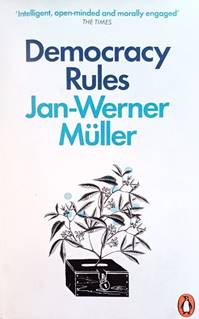
Müller’s book is kind of a primer for readers who would like to refresh their knowledge of the fundamentals of democratic political systems. For readers who are up to date about these fundamentals, Müller’s text can be boring at times. Patience might be needed most with chapter 4 “Reopening” (pp. 139-178), in which Müller recounts four requirements that must be fulfilled by “intermediary institutions” (political parties and the mass media): They must be accessible by citizens, they must support their judgements and opinions by facts, be autonomous (without hidden sources of influence), and thereby be accountable. Accessibility is of particular importance because any democracy “must be open to new claims of representation” (p. 140). Autonomy is closely related to political finance. Political parties or the mass media must not be dominated by a single person or group of people. Müller mentions several measures, such as the public funding of parties, tax deductions, and vouchers or “democracy coupons” that the state could give to the people, who could then distribute them to parties of their choice. Such measures are said to potentially have positive effects on political participation. However, Müller also notes that, “None of this promises better political outcomes as such, but it holds the possibility of opening up democracy to new representatives.” Such measures are aimed against what is called “the donor class” (p. 150). Something similar could also be applied to mass media organizations that do not operate to gain profit. Yet, their capture by influential financiers must be prevented, just as the case regarding political parties. Both regarding political parties and people-supported nonprofit mass media organizations, one might wonder how many citizens could develop an interest in becoming engaged in these fields. In any case, besides the participatory element, citizens must also be able to assess these two components of “democratic infrastructure,” that is, they must be transparent regarding their internal operations.
The second-last section of this text is headlined, “Closing Democracy to Save Democracy” (p. 158ff.). The question is, “What about bad actors bent on undermining democracy, on playing the democratic game in bad faith?” (p. 159). Of course, this leads to the consideration what is generally called “militant democracy,” made famous regarding the defeat of Germany’s Weimar Republic by the Nazis, and the subsequent inclusion of “militant democracy” in the post-Nazi Basis Law of the Federal Republic of Germany. In practice, this mostly is about the banning of parties that openly declare that they would abolish the democratic order once in power. Two other ways of fending off threats to democracy are constitutional courts (presuming that they are impartial, which can hardly be said for countries such as, say, Poland, Hungary, or Thailand). The second option, if all other means fail (this is the last section of the main text, though there is still a “Coda”), could be measures of civil disobedience. Based on Rawls, this entails “overt lawbreaking,” which must be nonviolent and aimed at persuading fellow citizens that their democracy faces dire problems. Yet, this last condition might not work when the national public has already been distorted by the capture of the mass media. Should oppositional forces declare defeat when they realize “that their criticism of the democratic process fails to resonate with other citizens?” (p. 176). Another tricky part here is that lawbreakers must be prepared to suffer the respective legal punishments that, however, would only work if the legal system is, by and large, fair. But this might not be the case when anti-democratic forces have already undermined, or even captured, the judiciary. Maybe, “uncivil” actions of confrontational social sanctions could be used. But they must directly target the concerned person and strictly avoid “collateral damage” (such as scaring children when actions are taken in front of the house of the targeted person).
I will now turn to the beginning of the book. Müller assesses democratic declines in several countries (obviously, the USA, Trump, and right-wing populism are favorite references since he teaches at Princeton, but Poland, Hungary, India, Israel, and Brazil are also mentioned). One important issue that is mentioned variously in the text is stated on page xi, “…it is not the people who decide to be done with democracy; it is elites.” So far, there have not been examples of citizens living in democratic systems declaring that they, from now on, would prefer living under an authoritarian regime.
The first chapter is about “fake democracy,” beginning with populism. Populists are not only nationalists. Above all, “they do something else, and that is crucial: in one way or another, they claim that they, and only they, represent what they often refer to as the ‘real people’ of also the ‘silent majority.’” (p. 6, original italics). In other words, they claim to have a “distinctly moral monopoly of representation” (ibid.). Populism thus thrives on polarization of the “real people” and those who do not belong into this category, but rather present a threat to the former (refugees, migrants, Muslims). Thus, the question remains who, in fact, belongs to the people of a political order, to its demos. In this respect, Müller talks about what he calls the “double secession” (p. 23). The first secession is that of the wealthy who do not really depend for their reproduction on nationally organized political, social, or economic structures. As for the USA, “this de facto secession relies not on any kind of conspiracy but on controlling one of the two major political parties” (p. 29f.). The second secession is that “an increasing number of citizens at the lower end of the income spectrum (to put it very neutrally) no longer vote or participate in any other form in politics” (p. 31). This can become reinforcing because “political parties have no reason to care for those who don’t care to vote” (ibid.). This way, the national political order becomes deeply divided: “At the top, the nation features citizens highly engaged in politics but who have everywhere else to go; the separate nation at the bottom consists of men and women highly disengaged who have pretty much nowhere to go,” while the middle class comes increasingly under stress (p. 33). The second and the third strata might become disenchanted with democracy, not the least because they cannot see that their children will have a better living standard in the future. Thereby, there is a reservoir of citizens who feel neglected, and this reservoir can be exploited by populists. However, against them, one must insist that democracy has two “hard borders.” “First, a distinctly democratic people cannot expel or disenfranchise citizens…” (p. 39). “Second, in struggles over boundaries, one cannot simply assert a supposedly self-evident conception of the people. That is what defenders of a particular ethnic conception of the nation ten to do…” (p. 40).
The second chapter is about “Real Democracy: Liberty, Equality, Uncertainty.” Simply speaking, in a democracy, people are citizens, that is, they are equal. This does not mainly refer to equal right but rather to social equality, meaning that people “consider one another equal (but not the same)” (p. 43). Such a fundamental standard cannot be achieved in structurally hierarchically societies, which, for that reason, can also not be (fully) democratic. Such a view does not include ideational homogeneity and a dislike for conflicts. Rather, pluralism and conflict are a quasi-natural component of democratic political orders. It thus makes no sense to demand something like “political unity.” For this reason, in a democracy, the occurrence of “unprecedented political association” is nothing to be worried about.
Often, the elements of “representation” and democracy” come together in the form of “representative democracy.” But are they the same or, more importantly, does representation undermine democracy? “That is obviously what the American founders thought. Thet considered representation a distinct alternative to democracy, which for them meant continuous, direct participation by the people” (p. 57). Since elections are the key mechanism to determine, Müller spends several pages on this issue, especially about the “democratic art of losing.” It needs to be emphasized that “A democratic election is not a one-off aggregation of preferences but the end point of an extended process of citizens’ engaging one another, as a result of which losers can also understand themselves at least somewhat as the authors of the collective outcome” (p. 63). From this follows the losers’ commitment to becoming a “loyal opposition” (p. 64; original italics). “Loyalty” here refers to the “procedures of democracy” (ibid.). In other words, the losers of an election will not support the government, but they will support the democratic political order. “The alternative to a loyal opposition is not consensus but behind-the-scenes intrigue or chaotic issue-by-issue fights” (ibid.). However, it is not only the opposition that must accept the winners, meaning the government. The winners, meaning the government, must also accept the opposition and its persistent criticism of its actions. Such criticism is not just a distraction of governmental work, it is a constitutive part of the democratic process. The opposition provides a “systematic, coherent, but precisely not anti-system alternative” (p. 65). This arrangement can be endangered when anti-system right-wing populist parties gain ground. When they become numerically too strong, it might be necessary that all pro-democratic parties join in creating a government, producing an opposition that is disloyal to the democratic political system. This could play into the populists’ hands because it lends weight to their accusation that the people are up against dominant elite forces that do not care about the people.
In principle, the outcome of elections must be uncertain. The author quotes Adam Przeworski, who had defined democracy as a kind of “institutionalized uncertainty” (p. 71). Winners and losers must have the opportunity to be turned into their opposites. Perhaps even more important, “new winners and losers [must be able] to enter the game over time” (p. 72). This implies that the electorate will not be fixed in its distribution of opinions. Otherwise, one would need only one single election to settle once and for all who will be the government and who will be the opposition. And one should not fall into the trap of creating too high normative hurdles for the voters’ decision-making process.
It’s easy enough to demonstrate that individuals lack all kinds of politically relevant knowledge or have inconsistent views. But it does not follow that politics as a whole becomes arbitrary, let alone that political prizes will always go to the greatest demagogue. Citizens do have a good enough sense of their interests; they pick up cues from other individuals and institutions (parties, the media, and organizations that as trade unions); as in so many other areas of life, taking a shortcut is not a sign of irrationality. (p. 76)
Compared to the voters, the bigger problems are posed by the state of political parties and the mass media. It is also about the unequal distribution of organized interests, and the possibility that influential organized interests might be able to lose in elections. As mentioned above already, especially regarding the issue of representation, “The easier it is to enter the game of offering oneself and particular representations of shared interests to groups in society, the more likely it is that citizens will experience their political system as free and open to change” (p. 84). In this context, Müller touches on alternatives to representation, such as lottocracy and meritocracy. He notes that representation and participation should not be seen as opposites. Rather, “the antithesis of representation is exclusion, and the opposite of participation is abstention or some form of secession from shared political life” (p. 88).
Chapter 3 turns to the “Critical Infrastructure” of a democratic political system, meaning political parties, movements, and the mass media (he also uses the expression of “public sphere”). The first is about the basic question of, “How can citizens become active and exert any power at all if no organizations exist to help them shape and spread their views?” (p. 91). Apparently, Müller’s conceptual starting point is the opposition of state and society. Thus, he calls the above organizations “intermediary institutions.” Of them, political parties and the mass media are often perceived by observers as being in crisis, while both are seen as being indispensable in providing aggregate opinions on issues and offer their positions, or choices, to society, depending on their respective “value commitments” (p. 102). Since those values are never unitary, both political parties and the mass media must be pluralistic. However, this “external pluralism” must be complemented by “internal pluralism,” that is, what others might call, especially regarding political parties, “internal democracy.” This does not contradict partisanship since partisanship relates to competing units, while a political party’s partisanship can be expressed in different ways without losing its hard core. Yet, debate cannot go on forever; in the end, some kind of “common program” (p. 108) needs to be agreed upon. After all, political parties are supposed to structure the political game, and this is impossible if a broad spectrum of options is not reduced to a program that the electorate, as well as competing parties, can recognize is being clearly different from the programs of its competition.
There are also some pages about the role of the mass media, the previous connection between political parties and newspapers, public broadcasting channels, and the internet. Regarding the latter, the author emphasizes that one cannot assume that technology as such has an effect. Rather, what kind of use is being made of those new technologies depends on the regulatory framework that is applied to them. Thus, it is a matter of policy decisions, and not an issue of the eigengesetzlichkeit of technological innovation (just as in the earlier cases of radio and cable TV). Insisting on the professionalism of mass media earns its proponents the label of “elitists” by populist critics. Another problem is what Müller calls “news deserts,” meaning areas in the rural US where there are no independent newspapers any longer. The question then arises how local people know what is going on in their wider locality. This also impacts on the degree of national representation because people might not really know much about what their representatives are doing in Washington, or even in their state’s legislature. Consequently, holding them accountable becomes problematic. Moreover, national news channels are more about polarizing conflicts and political-cultural identities. Of course, political parties have always targeted specific groups of voters. In so far, talk about the dominance of “echo chambers” might be exaggerated. On the other hand, if indeed people come to be “trapped in politically homogeneous spaces,” elections could become superfluous. Election commissions only needed to count the self-declared members in those spaces and then declare the winner. In any case, the electoral outcome would become less uncertain because one would have to assume that the boundaries of such spaces can hardly be overcome in election campaigns.
At the end of this section, Müller asks “Is the Party Really Over.” He lists a number of points (loyalty to strong leaders, rather than to programs, platform parties) from alternative political parties in Europe that seem to indicate that the life of traditional political parties has not become easier in the last few decades.
At the end of the book is a section headlined “CODA: Five Reasons for Democratic Hope (Not Optimism)” (pp. 179-185). It is clear that “Millions of people around the world are evidently dissatisfied with their democracies. But they are not turning away from democracy as a set of ideas. … This is a reason for hope; it’s also a real difference from the twentieth century, when citizens felt that institutions like parliaments were deeply discredited as such” (p. 179). Consequently, rather than being openly anti-democratic, some parties revert to “faking democracy” (ibid.). That is, even such parties cannot openly attack the democratic fundamentals. One should also be hopeful that what politics has produced can also be revised by politics. Another reason for hope is that some countries have been trying to provide tools to the people so that they might recognize that they have more in common with each other than the emphasis on divisions might suggest. A final reason for hope is that “distinctly democratic form[s] of disobedience” have often remained possible, which means that such systems have retained a degree of openness. In short, democracy cannot be saved by professionals; “ultimately, only mobilized citizens can” (p. 185).
MHN
Nonthaburi/Thailand
11 December 2023
 Books worth reading
Leave a comment