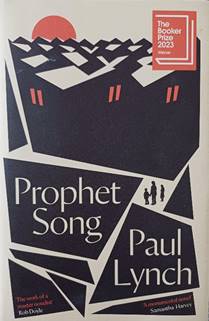
This is the second novel about people living in an authoritarian/totalitarian political system that I have recently read. The first one was Celeste Ng’s “Our Missing Hearts.” It is about a fictional USA in times of anti-Chinese racism (https://www.researchgate.net/publication/376303904_Celeste_Ng_2022_Our_Missing_Hearts_London_Abacus_Books_335_pp ). Paul Lynch’s novel—which won the Booker Prize 2023—turns Ireland into a fictional totalitarian state. Where Ng’s writing is direct and clear, a reviewer praised Lynch for his “beautiful, lyrical prose.” The following quote from p. 176 might serve as an example:
This feeling the attic does not belong to the house but exists in its own right, an anteroom of shadow and disorder as though the place were the house of memory itself, seeing before her the remnants of their younger selves, the self folded, packed into boxes, bagged and discarded, lost in the disarray of vanished and forgotten other selves, the dust laying itself down upon the years of their lives, the years of their lives slowly turning to dust, what will remain and how little can be known about who we were, in the closing of an eye we will all be gone.
I found this style somewhat distracting and, therefore, tried to just follow the flow of the story. Since I am an elderly German who cannot escape the memory of the Nazi regime (though I was born only in 1952), and who carries with him the experience of the German communist state (though I lived in West Germany), this story and its elements are predictable enough. So, on page 76, I thought I would quit. But since I had spent money for buying the book, I nevertheless continued, perhaps helped by the author’s fluent writing style, and my curiosity about how his imagination would fill the remaining pages. This approach brought me to the final chapter 8 (pp. 238-309), which I think is the strongest part of the book. Lynch succeeds to describe—step-by-step—the nightmarish almost total collapse of the protagonist’s remnants of an ordinary life, until she is left with the material and emotional ruins of her very recent past and only with a faint ray of hope for a peaceful future for herself, her baby, and her teenage daughter, Molly.
Lynch constructs his story by focusing on how an anti-regime family deals with a political system that has increasingly turned into a totalitarian monster. The family comprises Larry, his wife, Eilish, their teenage son, Mark, his younger siblings, Bailey and Molly, and the baby, Ben. Larry has a physical presence only at the beginning of the book. He is a Union organizer and wants to attend a big anti-regime rally. Eilish does not stop him from going out, though both know that the regime plans a crackdown. Indeed, thousands are arrested, and Larry disappears without any trace. Subsequently, Eilish tries to locate him with the help of sympathetic solicitors for a long time. Of course, these attempts are futile. Nevertheless, she remains hopeful, often speaking to herself as if she is speaking to Larry.
She struggles to explain what is going on to her four children. Moreover, she must manage the household and care for her father who suffers from dementia and lives in a different house. All this does not get easier when she is kicked out of her job by the ruling party. Things take a turn for the worse when a rebel army starts a civil war against the regime, and Mark joins them. Eilish’s and other houses are severely damaged when regime forces bomb the area where she lives. While she is more slightly wounded in the attack, Bailey has a shrapnel stuck in his skull. A nurse provides first aid and says that Eilish needs to bring her son to a hospital so that the shrapnel can be removed.
This is the situation that will lead us to chapter 8.
MHN
Nonthaburi, Thailand 5 February 2024
 Books worth reading
Leave a comment