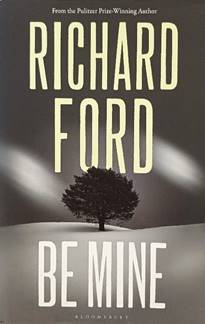
This is the latest installment in Richard Ford’s series about Frank Bascomb. In the opening chapter, Frank reflects about “Happiness.” He has become old by now. Fate has it that his son, Paul, who is 47, has become sick with Lou Gehrig’s disease, a terminal neurodegenerative disorder (ALS), for which he was treated at the Mayo Clinic in Rochester. The final chapter of this novel has the same title: “Happiness.” At that point, Frank’s son had already died, obviously from a different disease. He wonders whether by dying from that disease, his son was “‘lucky’” because with ALS, people “can live for years, lose all but their cognitive powers (which do not require muscles) then die as miserably and as surely as they would had they only lived a year—like my son” (p. 330).
In between these two chapters, Frank drives his son to the clinic where he was in an experimental treatment program. And he makes plans to organize a final trip with Paul to Mount Rushmore. Before this can start, Paul must still undergo some more proceedings at the Mayo Clinic, and Frank needs to find a camper big enough for both of them, and convenient for his son, who mostly moves around in a wheelchair. They find a large “Windbreaker” camper (Dodge 1500). “‘Awesome. Fucking awesome,’ Paul said … ‘It’s all built inside,’ he said, shuffling around below the open doorway. ‘Everything’s accessible. Space is the limiting factor—but not really.’ He flashed around at me again. ‘Don’t you think it’s fuckin’ great?’” (p. 90f.).
All the while, it is freezing winter, and the general atmosphere in this novel is of a gloomy America, nothing attractive or hopeful. Frank is also overcome by a certain longing for something more encouraging, sensory, conversational. As he puts it, “Spending most all of one’s waking hours with someone who’s dying—even if that someone is your son—should demand at least some attention to one’s own prerogatives” (p. 103, original italics). In his case, an opportunity arises (after they had arrived in Rochester shortly before Christmas) when Frank comes across an ad in a newspaper, “Vietnamese Massage Specialty. Women and Men Welcome. Locally Owned. Friendly. Reliable. Safe” (p. 105). That’s where he meets Betty Duong Tran, his “massage attendant.” She studies business at the University of Rochester and took $200, without Frank precisely knowing what he had to expect from his visit. It’s not a matter of sex, but of massage and conversation, food for the soul, not for satisfying one’s lust. He even took her out for dinner several times, hoping that she has some affection for him—besides the business aspect of their relationship. This went on for six-plus weeks, while his son attended activities at the Mayo Clinic.
On page 193, Frank and his son finalize the rental of the Windbreaker camper. They leave Frank’s car at the place, and their final joint trip to Mount Rushmore can begin. Father and son arrive there on page 313. Entrance is free since it is Valentine’s Day. Frank muses, “I cannot completely believe I’ve brought this unlikeliest of moments about, and can be here standing where I’m standing—with my son. How often do anyone’s best-laid plans work out? How often are promises kept and destinations achieved? I’ll tell you. Not very goddam often. Buddhists profess all is the journey. Abjure arrival. But what do they know? They’re hiding something, like all religions. And yet. Something about the four presidents-on-a-mountain seems not exactly right to me” (p. 321, original italics).
MHN
Nonthaburi, Thailand
11 November 2024
 Books worth reading
Leave a comment