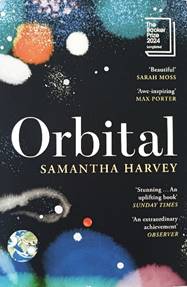
A novel that I briefly presented earlier (Adelle Waldman’s Help Wanted) was called a “workplace novel.” Samantha Harvey’s Orbital, in a sense, is also a workplace novel, though its choice of setting is even more unusual. Or has there been any previous novel on the international space station and its personnel? There are four astronauts on this station (Nell, Chie, Shaun, and Pietro) and two cosmonauts, as they are called in Russia (Anton and Roman). Obviously, this is not a novel about the group dynamics among the six of them. After all, they are highly specialized and trained individuals from Russia, the United States, Japan and Italy, who were chosen, among other criteria, for their balanced personalities, who had proven their capacity to live largely conflict free under cramped conditions in zero gravity. Harvey writes, “Don’t encroach, is their unspoken rule. Little enough space and privacy as it is, all of them stuck here together in each other’s pockets breathing each other’s overused air for months on end. Don’t cross the rubicon into one another’s internal lives” (p. 18).
Readers learn much about the conditions of life in such circumstances. For example, the astronauts/cosmonauts must exercise for two hours every morning, because without gravity that produced the need for having muscles, they will atrophy. They must not “give in to the seduction of weightlessness, nor her bones to birdies. Else that poor spacefarer will be in all kinds of trouble when she lands back on earth where legs, once more, are very much a thing. Without that hefting and sweating and pressing she would survive the blazing heat and tumble of her re-entry only to be pulled from her capsule and fold like a paper crane” (p. 12).
The real stars of the novel are the space station and, above all, the Earth. Harvey cannot get enough of writing which countries they have passed on their flight path (which is not really a flight but rather an endless falling of the space station, while the earth rotates beneath it), how the various landscapes look like from above, how the rising and setting of the sun above areas look like, or how typhoons build up their tremendously destructive momentum. Havey writes, “There are times when the rapidity of this passage across earth is enough to exhaust and bewilder. You leave one continent and are at the next within a quarter of an hour, and it’s hard sometimes to shake the sense of that vanished continent, it sits on your back, all the life that happens there which came and went. The continents pass by like fields and villages from the window of a train. Days and nights, seasons and stars, democracies and dictatorships. It’s only at night when you sleep that you’re relieved of this perpetual treadmill” (p. 125).
As in complex social endeavors more generally, the six of them are not really individuals. “They are specimens and the object of research who’ve forged the way for their own surpassing. … They are data. Above all else that. A means and not an end. … It was never really about them and it is not about them now—what they want, what they think, and what they believe. … it’s just about the future and the siren song of other worlds, some grand abstract dream of interplanetary life, of humanity uncoupled from its hobbled earth and set free; the conquest of the void. The six here might or might not dream this dream too, and it doesn’t matter if they dream it, it doesn’t matter, so long as they comply and play their parts. And this they do gladly day in and out” (p. 94f).
MHN
Nonthaburi, Thailand
28 October 2024
 Books worth reading
Leave a comment