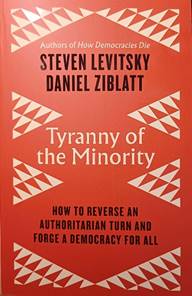
The authors of this book share Heather Cox Richardson’s view that the political system of the United States of America is at the “crossroads.” They could have added the subtitle of Richardson’s book, “Notes on the state of America.” Except for a few comparative references, the text is entirely about the US political system. Levitsky and Ziblatt have a more academic approach, and readers can learn much about US constitutional and political history. Their book can almost be read as a focused primer about such issues. In doing so, the authors’ basic approach is simple: The meaning of democracy is that, after free and fair elections, those who received majority support must be able to govern. This may sound like a truism, but their key point is that, in present-day America, it is the minority that dominates the majority. A “radicalized partisan minority” represented by the Republican Party has been subjecting the majority to its will, and constitutional “institutions [exist] that protect and empower it” (p. 257), which Levitsky and Ziblatt often refer to as “counter-majoritarian institutions.” While other democratic countries around the world have, over the years, adapted their institutions to changed societal conditions, needs, and ideas, the USA has not. From being a model to be emulated by democratizing countries, the USA have become a “laggard” (p. 216) and an “outlier” (p. 198).
Among the key “counter-majoritarian institutions” are:
- A Supreme Court whose judges enjoy lifetime appointments, which means that a generational gap opens between them and the majority of the population, and this usually includes a gap regarding values and norms.
- Federalism, which means that many areas of lawmaking are not accessible to national majorities.
- “A severely malapportioned Senate,” in which all states have two members, independent of the size of the respective states’ population number.
- “The filibuster, a supermajority rule in the Senate (not in the Constitutions) that allows a partisan minority to permanently block legislation backed by the majority” [in the House]. The authors mention that, at earlier times, a filibuster had to take place physically in the chamber, while, presently, any Senator could just register his or her intention to filibuster, thereby basically making such an exercise having no cost at all. And since there is a high hurdle for ending debate and coming to a vote (three-fifth of its members), a filibuster means that any legal measure adopted by the House could die in the Senate. “As filibustering became costless, what had once been rare became a routine practice,” p. 163). Regarding the cloture aspect, the authors note, “America thus entered the twenty-first century with a ‘sixty-vote Senate’.” (p. 216)
- The indirect election of the president via an Electoral College. Here, smaller states have an advantage, and presidents can be elected by a majority of electors in the College without having gained the majority of the public vote. [The most infamous example perhaps being that, in 2016, Hilary Clinton gained 2.8 million more votes than Donald Trump. Nevertheless, the loser—Donald Trump—became president, while the winner—Hilary Clinton—became the loser.]
- “Extreme supermajority rules for constitutional change: a two-thirds vote of each House of Congress, plus approval by three-quarters of U.S. states.” (adapted from p. 148).
- “America also retained its first-past-the-post electoral system,” which could, especially in state legislatures lead to minorities dominating majorities. “The United States thus joined Canada and the U.K. as the only rich Western democracies not to adopt more proportional election rules in the twentieth century.” (p. 215)
Eventually, the authors arrive at the point where they need to suggest what changes they think were needed to create a “truly multiracial democracy” (p. 258). Chapter 8, thus, is about “Democratizing Our Democracy” (pp. 225-258). Looking to the immediate future, they note, “The conditions that gave rise to the Trump presidency—a radicalized party empowered by a pre-democratic constitution—remain in place” (p. 225). [Levitsky and Ziblatt do not say much about the very basis of the radicalized Republican Party, by which I mean the radicalized electorate. Its existence is not Trump’s achievement, but, as they point out elsewhere in the book, he was very good at addressing those voters’ grievances and values.]
On pp. 230 to 236, Levitsky and Ziblatt summarize their proposals under three headings:
UPHOLD THE RIGHT TO VOTE
- The right to vote should become a constitutional right, “which would provide a solid basis to litigate voting restrictions.”
- When American citizens turn 18, they should automatically be registered as voters. [Hard to believe as it may seem, but the US leaves voter registration to the voters themselves, rather than establishing automatic voter rolls.]
- Early voting and mail-in voting should be expanded.
- Voting should take place on a Sunday or a holiday, “so that work responsibilities do not discourage Americans from voting.”
- Ex-felons should be allowed to vote.
- “Restore national-level voting rights protections,” This should apply to all jurisdictions, not only to those suspected of foul play.
- Partisan electoral administration should be replaced by elections that are administered by professional officials.
ENSURE THAT ELECTION OUTCOMES REFLECT MAJORITY PREFERENCES
The authors introduce this section by stating the obvious [which is not that obvious in the US context]: “Those who win the most votes should win elections. Nothing in democratic theory justifies allowing losers to win elections.” (p. 233)
- “Abolish the Electoral College and replace it with a national popular vote.” (p. 233)
- “Reform the Senate so that the number of senators elected per state is more proportional to the population of each state…” (p. 233)
- “Replace ‘first-past-the-post’ electoral rules and single-member districts for the House of Representatives and state legislatures with a form of proportional representation…” (p. 234)
- “Eliminate partisan gerrymandering via the creation of independent redistricting commissions such as those used in California, Colorado, and Michigan.” (p. 234)
- The Apportionment Act of 1929 fixes the number of members of the House at 435. This does not take into account population growth making the proportion of one representative to voters extremely high. Increasing the number of House members could also serve to bring the representatives closer to the people.
EMPOWER GOVERNING MAJORITIES
- The filibuster must be abolished, because minorities should not be able to permanently block legislation that the majority wants to pass.
- Supreme Court judges should lose their lifetime appointments (they suggest 12 or 18 years). Every president should have the opportunity to appoint the same number of judges. “This would also limit the court’s intergenerational counter-majoritarianism.” (p. 235)
- Constitutional amendments should be made easier by eliminating the requirement that three quarters of states must ratify them. Instead, two-third majorities in House and Senate should be sufficient.
“These reforms we propose might appear radical, but they are already in place in the vast majority of established democracies…” (p. 236)
Levitsky and Ziblatt, of course, realize that achieving these changes will not at all be easy. To them, they serve as issues to be put on the agenda and be kept there for as long as it takes. But it is not only an agenda issue. Equally important, perhaps even more so, is the issue of mobilization. They stress that all major changes, from Woodrow Wilson to Franklin Delano Roosevelt, and Lyndon Johnson, were preceded by long-lasting social movements. “What is needed today, then, is not only a democratic reform agenda but a democratic reform movement capable of mobilizing diverse citizens in a sustained nationwide campaign to ignite imaginations and change the terms of public debate.” (p. 249 f, original italics) The authors see partial movements such as Black Lives Matter and pro-democratic movements during the Trump presidency as examples. They also mention Protect Democracy (founded in 2016), and Gen-Z for Change. There are even Republican voters who mobilize against Trump, such as Republican Voters Against Trump or Republicans for the Rule of Law.
In short: “Defending democracy is tiring work.” (p. 256)
MHN
Nonthaburi, Thailand
27 January 2024
 Books worth reading
Leave a comment