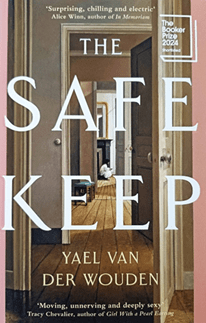
This novel brings us back to a theme that was raised in other entries to this list of recommended books: Nazi Germany and its mass murder of Europe’s Jewish population (Anne Berest, Michael Frank, Margot Friedlander, Ruth Kluger). The Safe Keep is set in the Netherlands of 1961. Isabel lives alone in a huge house. One of her brothers, Hendrik, lives in a same-sex relationship while another brother, Louis, is a womanizer. One day, Louis asks Isabel to let his then-girlfriend, Eva, live with her for a while because he had to be away on a business trip. Eva had been introduced to Henrik and Isabel earlier. Her impression of Isabel was unflattering: “Her face, I swear. Not even honey could sweeten that vinegar” (p. 209). Nevertheless, when staying with Isabel in the house, they engage in a passionate lesbian relationship. This part of the novel has some very inspiring, if I may say so, descriptions of the sexual side of their relationship. Eventually, however, Isabel kicks her out of the house because she discovers that the many items that had gone missing from the house (teaspoons, knives, letter opener; see the list from Eva’s diary on p. 216) were stolen by Eva.
In fact, they were not stolen. It was Eva’s way of trying to regain at least some of her family’s property from the house where she lived with her family when she was a small child. When Isabel’s family moved into the house, all the furniture of Eva’s family was still there. One family had moved out and left everything behind, while another family moved in and continued using everything that they found in the house. After she had kicked Eva out, Isabel tried to find out what all this meant. She visits her uncle Karel, who had acquired the house for her family to live in. On Isabel’s insistence, he says,
Yes, a family lived there. But they left. They did not pay their mortgage, they did not pay their taxes. This happens every day, people make gambles they cannot keep, people pack up and leave and they don’t take their plates and their spoons. Goodness! Do you understand? It happens every day. There is nothing untoward here, Isabel. It’s the law.” (p. 222)
In fact, there was very much “untoward” to the acquisition of the house. The Nazi army occupied the Netherlands in May 1940. Eva’s family was Jewish and had gone into hiding in Friesland, until Dutch neighbors informed the Germans of their existence.[1] In short, the mortgage for the house was not paid because Eva’s father was murdered in a Nazi concentration camp. Jewish people sent to these camps were only allowed to take with them what items they could carry, which accounts for the fact that the house was still full of their furniture and other belongings. Eva and her mother survived. After the war, they went to their home and demanded access but were brusquely refused. Eva experienced this as a child outside the entrance, Isabel, also still a child, experienced it in the house.
Isabel, in a mixture of feeling guilt, her loneliness, and her love for Eva finds out where she lives and visits her. Their encounter is unfavorable. Isabel returns to the house, and readers might wonder at this point how the author will close her novel. Of course, there could not be a Hollywood-style happy ending. Nevertheless, one day, there are bangs at the door. Isabel opens and sees Eva. Eva says, “I didn’t—think. God this was a bad idea, oh God I should—” (p. 252). Near the end of the novel, Eva says to Isabel “‘Look at me.’ Isabel looked at her. Eva kissed her. It was a hard press of lips over teeth, angry and then soft. Eva’s breath was hot. She was still weeping. ‘I’ll never leave,’ she said. It sounded like a promise. ‘If you are mine then I am yours. Do you understand? If I stay, if I’m yours then you must keep me, and I can never—’ The chair scraped and Eva was on her knees, too, and Isabel held Eva under the fall of her hair and they swayed” (p. 257). The next day, Isabel stood by the window while Eva came from behind. “She knew Eva was there, knew she had approached. She would never not know. She would never leave a room again and not leave half of her behind” (p. 258).
MHN
Nonthaburi, Thailand
30 December 2024
[1] The Dutch Central Archief Bijzondere Rechtspleging, or CADR, has recently begun the digital publication of lists of Dutch collaborators with the Nazi’s occupation forces. The list contains about 450,000 names (DER SPIEGEL, 2 January 2025).
 Books worth reading
Leave a comment