435 pages
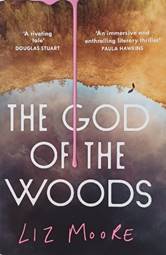
At 435 pages, The God of the Woods is a rather long mystery novel, divided into eight parts. Each part contains short sections headlined by character names. There are eight in total, five of them women. Louise has 18 entries, Tracy 15, Alice 17, Judyta 30, and Barbara 1. Among the men, Jacob, Carl, and Victor have a combined 14 entries. Key characters such as T.J., Peter Van Laar, John Paul McLellan, and Denny Hayes are present in many sections, though they are cast in supporting roles.
The narrative spans from the 1950s to August 1975, with a strong focus on the years 1961 and 1975. Flashbacks are used extensively to contextualize current events. Each section’s header includes a date range, with the relevant moment in boldface. Despite the book’s length, the fast pace, driven largely by dialogue rather than narration, makes for engaging reading. For me, I looked forward to my two nightly hours with this book; about 100 pages from the end, the suspense became so intense that I could hardly put it down.
The story is set in a summer camp for children between the ages of eight and sixteen, located on the Van Laar family’s forested estate near a lake and mountains. One of the camp’s highlights is the survival days, when small groups of children must survive in the forest using the skills they have learned, with minimal adult supervision. The Van Laars are a wealthy banking family. Their daughter Barbara—a rebellious, punk-style teenager—is usually averse to attending camp, though she resides on the estate. This year, she chooses to join, arriving a day late. Her bunkmate, Tracy, is a shy girl who tends to stay on the fringes of social interaction. Surprisingly, Barbara becomes her only friend, and later, Tracy reflects that what she liked most about the camp was the way Barbara helped her become a more confident teenager.
Barbara’s sudden disappearance sparks the central plot. Louise, her cabin supervisor, is the first to notice she is missing. This event reawakens old traumas, particularly the 1961 disappearance of Barbara’s younger brother, Peter (nicknamed “Bear”), whose body was never found. He had been the emotional center of his mother Alice’s life. Barbara’s case leads to the reexamination of Peter’s. Local police, led by Denny Hayes and his newly appointed female investigator Judyta (“Judy”) Luptack, take charge. Judyta, from a Polish immigrant family, unexpectedly becomes a central figure in the investigation, despite being new to the job. Her rapid professional development may strike some readers as overly convenient.
The novel unfolds along two investigative tracks: finding Barbara and uncovering the truth about Bear’s disappearance. Ultimately, Bear’s death is explained, though the manner in which the police discover his remains feels somewhat contrived. As for Barbara, Liz Moore plants red herrings: when her love interest is found with a bag of her bloody clothes, suspicion arises. Readers, however, know Barbara had injured herself while gutting a dead squirrel during the survival exercise, and T.J., the camp director (daughter of Vic, whom she succeeded as the director), treated her wound and disposed of the bloody clothing. T.J., who had taken care of Barbara like a younger sister (or perhaps even like the daughter she might never have) when the Van Laar parents had no time to do so, then misleads the police by suggesting the person with the clothes may have killed her. This contradiction might make readers suspect that T.J. is hiding something or protecting someone.
What happened to Barbara? Was she murdered, did she run away, or did she simply get lost in the forest? In the end, it falls to the determined but inexperienced Judyta Luptack to unravel both past and present and uncover what really happened to Peter and Barbara.
The assistance of ChatGPT is gratefully acknowledged.
MHN
Nonthaburi, Thailand
29 April 2025
 Books worth reading
Leave a comment