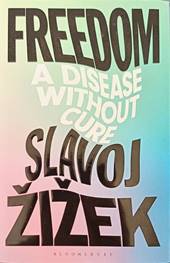
Admittedly, I am not normally a reader of Slavoj Žižek. I have only watched or read a couple of interviews with him. Nevertheless, I bought this book because I am interested in its topic and thought that he might have something interesting to say about it. Readers should be warned that the title is misleading, since only the first 52 pages directly deal with the topic indicated. The rest is a collection of texts and appendices on a variety of unrelated issues.
Žižek, like many observers and actors, sees the world as facing a multifaceted crisis, including digital control, viral infections, and global warming. He puts his hope in philosophy as a means of finding solutions. Quoting Alain Badiou, he writes that philosophy is tasked to “corrupt the youth” (p. 3), i.e., to alienate them from the dominant ideological-political order. As Goethe put it, “None are more hopelessly enslaved than those who falsely believe they are free” (ibid.; cited from Wahlverwandtschaften). Only by studying philosophy, Žižek argues, “will we find a way out of our sad predicament” (ibid.). This begins with analyzing the notion of “freedom,” which in liberal-democratic societies may be only subjectively felt, while “the establishment controls” our thinking (ibid.). Kant and Hegel, according to the author, saw freedom as a “disease,” a condition inherent to humanity, requiring discipline and education. “Discipline or training changes animal nature into human nature” (p. 4; Kant, “Lectures on Pedagogy”). The inherent “savagery” in human nature necessitates constraints. This eventually leads to a “hegemonic discourse of power” (p. 7), which must be resisted through language, not only in its formal structure but also its “non-intended ambiguities and wordplays” (ibid.), which create a space for resistance.
The everyday notion of freedom has been called into question by modern neuroscience, raising the issue of whether humans are truly free, or if our actions are determined by unconscious neural processes. Is there such a thing as free will, and can it coexist with scientific determinism? (p. 9f.). In the past, the biological foundations of conscious choice were acknowledged without assuming they impacted the content of choices. Today, however, neurological and digital means of control have expanded to such a degree that “the liberal notion of a free individual becomes obsolete and even meaningless” (p. 10).
From this, Žižek derives five questions: (1) Is the subconscious a site of determinism or freedom? (2) Does brain science leave room for freedom, or must we accept determinism? (3) Do modern social structures like the market, state, and democracy support or obstruct freedom? (4) Does the digital universe give rise to new, opaque forms of domination? (5) What is the impact of the ecological crisis on our freedom?
At the end of this introductory section, Žižek complains that capitalism involved “permanent self-revolutionizing” (p. 11), which has led to fundamental changes during the past fifty years. Somehow, he seems to be overcome by nostalgia for periods of life in which hardly anything ever changed, or at a much slower pace. Thus, he wonders, “perhaps, the time has come to re-conceive Communism as a counter-revolution, as an effort to establish a new stable order” (ibid., original italics). [I could not make out whether this remark was meant seriously or merely served to indicate the strength of domination that is exerted by modern world structures, leaving little room for individual choices, or put them under immense pressure of adaptation. M.N.]
The main part of the book, “Freedom as Such,” is divided into several sub-sections:
1. Freedom and Its Discontents
The author begins with the difference between “freedom” and “liberty,” referencing Wikipedia and then using Hegel to distinguish between “abstract freedom” (doing whatever one wants) and “concrete freedom” (freedom embedded in social norms and structures). “My freedom is only actual as freedom within a certain social space regulated by rules and prohibitions” (p. 19). The author’s example is that one can walk along a street without having to be afraid of an attack. And if one happened, one could be sure that the attacker, if caught, would be punished. In short, “a domain of rules is needed as the very terrain of our freedoms” (p. 19). Therefore, “a social space is not just the space of what is permitted but also the space of what is repressed, excluded from public space…” (p. 22). A domain of rules thus becomes the very terrain of our freedoms. Moreover, notions of freedom are historically contingent. Today, freedom is often equated with the capacity to choose. But this ignores how the available choices are framed and which are privileged (p. 25). With respect to Hegel, the author notes that there can be situations were “abstract freedom” needs to be adopted. And he asks, “Are we not more and more approaching a situation in which millions of people think that they have to act freely (violate the rules) in order to protect their liberty?” (ibid.). He includes “the Rightist populist revolts” (p. 26) in this context: “Did the Trumpian crowd not invade The Capitol on January 6, 2021, to protect their liberty?” (p. 26). One might then assume that the spread of populism is indeed a revolt against elitist rule that has imposed socio-political conditions on the people and that these people use populism to recover their oppressed liberty. Žižek asks, “Is our only choice the one between parliamentary elections controlled by corrupted elites and uprisings controlled by the populist Right?” (ibid.).
Somewhat controversially, Žižek claims that living under a “moderately authoritarian regime” may offer clarity: one knows the rules and how far one can dissent. [Singapore springs to mind. M.N.] By contrast, democracy produces disorientation. People may value the appearance of choice more than the burden of decision (p. 27). “The whole point of law is to regulate its violations: without violations, there would have been no need for the law” (p. 29).
Even in areas governed by facts, such as science, choices are not guaranteed. People can reject evidence despite knowing it. Žižek concludes that “true freedom is when we choose the contours of our “liberty” that will determine our entire life” (p. 34).
Freedom to Say NO
Freedom involves the ability to negate: to say no to one’s own inclinations. Quoting Benjamin Libet, Žižek says, “the ultimate act of freedom is to renounce what one desires most” (p. 35). Yet, such freedom may be illusory—a “user’s illusion”—concealing that actions are determined by unconscious processes (p. 36).
2. Is There Such a Thing as ‘Free Will’?
Žižek interrogates “deterministic naturalism”: the idea that we do what we will, but what we will is determined (p. 37). He revisits Libet, suggesting that consciousness might have veto power, only to concede this too may be predetermined. One possible rescue is contingency: decisions made in a space of randomness. But this introduces dualism, which Žižek rejects. Instead, he appeals to the emergence of “higher levels” of reality, such as social and spiritual domains, arising from physical processes yet possessing their own logic and causality (p. 40). However, there is a twist: “is the relative autonomy of the higher spheres an actual fact of nature or is it just a simplification that pertains to the limitations of our descriptions of reality, so that in a full description of nature no mention of higher levels would be needed?” (p. 41). He refers to Daniel Dennett’s dual-level theory (physical base and design level). [This sounds like a version of “structural coupling”. M.N.]. Dennett’s model allows higher-level investigation without denying the physical base. Dennett, however, is faulted for ignoring evolution and teleology. Žižek asks, “Is then the ‘teleological’ causality of motivation (I did something because I aimed to achieve some goal) just an epiphenomenon, a mental translation of a process which can (also) be fully described at a purely physical level of natural determinism, or does such a ‘teleological’ causation effectively possess a power of its own and fill in the gap in direct physical causality?” (p. 44).
Rewriting the Past
Pages 48 to 51 examine Althusser’s notion of ideological subject-formation. An open question is whether an uncanny subject precedes this subjectivization (p. 51).
Beyond the Transcendental
Reality, Žižek writes, is never given directly but through symbolic frames—the “transcendental” (p. 52), a view that closely aligns with epistemological constructivism. Our self-perception as free agents is not just a necessary illusion but the precondition of scientific knowledge. He criticizes Sabine Hossenfelder (a German theoretical physicist and proponent of “superdeterminism,” meaning that all human action and thought have physical causes) dismissing free will as “non-scientific nonsense,” siding instead with Michael Egner, who argues that if free will is not real, human thought loses access to truth (ibid.). [Readers interested in a comprehensive statement of determinism by a determinist may turn to Robert M. Sapolsky. 2023. Determined: A Science of Life Without Free Will. New York: Penguin. M.N.].
With this, Žižek’s direct discussion of freedom ends.
MHN
Nonthaburi, Thailand
10 May 2025
Editorial help from ChatGPT is acknowledged
 Books worth reading
Leave a comment