This book won the International Booker Prize 2025.
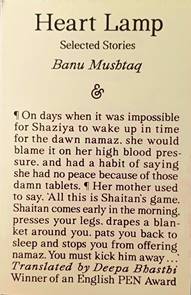
I found this collection of stories challenging. First, obviously, I am not familiar with the social and religious backgrounds of these stories. So, I frequently had to look up words to create an (imperfect) understanding of the situation. However, this is not at all a point that should prevent people from reading this book. Quite the opposite. It is one of its strengths. Secondly, I am more attuned to reading novels. When doing this, readers have 300 or 400 pages to get to know the characters and the plot. In Banyu Mushtaq’s Heart Lamp, readers have only 214 pages, but they must delve into twelve very different social situations with different characters (the leading roles are mostly female) and different approaches. They range from the sad to the comical, from relentless and heart-wrenching realism and desperation to the grotesque and to the challenges of different kinds of everyday life with the demands, obligations, expectations, and failures that, though unavoidable, bear heavily on the minds of participants. Banu Mushtaq’s rich writing style vividly brings the characters and their social situations to life, drawing readers in and encouraging them to engage deeply with both.
On pages 209 to 214, there is an informative text by the translator.
The first story, “Stone Slabs for Shaista Mahal,” ends with the unexplained death of Shaista Bhabhi, only a few weeks after she had a troubled birth of her seventh child. Before she gave birth, she had confided to the female narrator, Zeenat, that she wanted an operation to end future pregnancies. Zeenat cannot attend the ceremony of forty days after birth because she had to travel to see her mother, who had a serious heart attack. But she assumed that Shaista had fully recovered her good health after that birth. Zeenat’s mother dies after three days. She and her husband, Mujahid, stay for a few more days after the forty-day period of mourning and then return home. They visit Shaista’s home, noticing that the garden was unattended. They wait at the house since nobody seems at home. Eventually, Shaista’s husband comes out of her room. Zeenat asks, “Where is my Shaista Bhabhi?” Her husband answers, “She is no more. Before we could understand what happened, she had gone very far away from us.” (I am inclined to detect some sadness and bewilderment about what had happened to him in his statement.) Right after the forty-day period of mourning, he married a young girl from a poor family. After all, he had to take care of seven children. Though Shaista’s death is not explained, readers can safely assume that this death was altogether avoidable had she not given birth to so many children and earlier undergone the operation to prevent future pregnancies.
In the second story, “Fire Rain,” readers encounter a mutawalli, who oversees a charitable Muslim endowment. He lives with his wife and children near a mosque. One of his children is sick, cared for by his wife, Arifa. He is stressed because his youngest sister wants a piece of family property. Meanwhile, many people come to his house for help; election candidates visit him because they think he can deliver them the Muslim vote; a mother comes to ask him for help with a hospital bill for one of her children. Then, a big problem occurs: A corpse is discovered in a pond. It is assumed to be a Muslim man who had disappeared some time ago. His widow identifies the cloth as being his. The police do not care; they bury him in a Hindu cemetery. Of course, this causes a major upheaval in the Muslin community. A Muslim man buried without Muslim rites in a Hindu cemetery! A big effort results in the corpse being exhumed and brought in a procession to the Muslim cemetery. Just before the procession reaches it, the supposedly dead man turns up totally drunk and shouting obscenities at the people in the procession. After burying the corpse anyway, the mutawalli returns home. At this point, the story returns to its beginning. A daughter tells him that his wife has brought their small son to the hospital. His persistent fever for two weeks turned out to be meningitis. I was undecided about what was more comical, the stressed mutawalli, the fuss about the corpse in the wrong cemetery, being blown up to a matter of religious life and death, or the supposedly dead man turning up alive, though totally drunk.
The third story, “Black Cobras,” lacks any of the comical elements of the second text. “Black Cobra” is relentlessly realistic and heart-wrenching. The main characters are Aashraf (and her three daughters), Yakub (her husband and autorickshaw driver), and a mutawalli (a different one from the preceding story). After Aashraf gave birth to her third daughter (Munni), Yakub left her to marry another woman. He wanted a son who could take over his autorickshaw in the future. This might not have bothered his wife a lot. But he did not pay for her and her daughters’ (who were also his daughters, alas!) living expenses. Worse, he did not help with the medical expenses of sick Munni. His behavior had thrown Aashraf and her daughters into abject poverty. In her desperation, she wrote dozens of petitions to the mosque committee and the mutawalli, asking them to use Islamic law to force her husband to pay for their cost of living. Yet, the mosque committee kept silent and Yakub bribed the mutawalli. When they finally meet Aashraf at the mosque, Yakub violently kicks her. When she falls to the ground, she cannot hold on to Munni who flies out of her hands and dies on impact. At the end of this story, the mutawalli’s wife, Amina, gets on her way to have an operation done to prevent future pregnancies (she already has seven children). Earlier in the story, Amina had complained to her husband about how hard the frequent pregnancies were on her. She asked him, “If I bear one child per year, what will I become? Don’t you want me to live long enough to be a mother to these children at least?” That is, not to share the fate of Shaista from the first story. Yet, her husband cared more for his personal positional reputation than for his wife’s welfare (and by implication for the welfare of their children), saying, “I am the mutawalli; if people get to know that I got the operation done for a woman in my own house, I will have to be answerable to them, hamm.”
On the grimly realistic narration of the third story follows a domestic triangle of sorts in “A Decision of the Heart.” Akhila had born four sons to Yusuf, the owner of a well-established fruit shop. Yet, the marital peace is seriously disturbed by the fact that Yusuf’s mother, Mehaboob Bi, also lives in the house, though in a different section. Yusuf is his mother’s only child, and so he feels obliged to care for her in her old age, especially as she had been an exceptionally loving mother. From the beginning of their marriage, Akhila hated this arrangement. One day, early in their marriage, the wife and husband fought so badly that her brothers came to the house and beat Yusuf up. Akhira screamed at him, “You should have kept her! What did you marry me for?” Before that, she had cried, “You are making my stomach burn by behaving like a co-wife.” Yusuf tried to talk sense to her, to no avail. Readers might assume that Akhira’s heavily exaggerated jealousy indicates a stylistic choice of the author, making Akhira’s behavior almost look like a satirical performance. Eventually, Yusuf gets into a challenge with his wife. He agrees to find a new husband for his mother (without telling her). He employes a professional matchmaker, and after some trying, they identify an appropriate candidate who is willing to marry Mehaboob Bi. Suddenly, Akhira’s behavior changes entirely. She even invites community elders to her house to give testimony to her “foolishness.” Her performance on this occasion is complete with plenty of “tears pouring down her face.” Seeing this change in the behavior of his wife, “Yusuf was shocked. Was this … this was Akhira?” At some point, his mother starts speaking to the community elders, her son, and her daughter-in-law, accepting the arrangement that Yusuf had initiated. Yusuf, “very softly said, ‘Akhira, may you also have the good fortune of having your children arrange your wedding.’ And spat out enough bitterness for a lifetime.”
In the story “Soft Whispers,” the young female first-person narrator is woken up by a phone call from her mother. Since the family manages an important shrine, she wants her daughter to represent the family by taking part in the sandalwood ritual of the annual Urs festival. The caretaker named Abid would see her to make arrangements. The daughter asks her mother to ask him to see her in one hour. This brings her memory back to the time of her eighth birthday when she played with a large group of other kids in the village. Leading these kids was a tall boy, about fifteen-sixteen years old. His name was Abid. At first, the group played in a yard with many trees, trying to capture sparrows. Later, they moved to a pond in which the boys swam, while she was sitting on a rock. At one point, Abid moved her to another rock and kissed her on the cheek. Growing up, this same Abid became the caretaker and guru of the family’s shrine. Now, she waits for him to meet him. She wonders, “Would he be as rough as he was as a boy, would he have acquired a holy glow, or would he have a deceitful look on he face?” When he enters the room, she asks him, “Do you remember, Abid?” But he looks down to the floor, respectfully addressing her as “Apa,” only asking her to attend the festival on a given day. She still wonders about the boy he once was, but he does not give her an opportunity to find out, strictly keeping his eyes fixed on the ground.
Like “Black Cobra,” “Red Lungi” is a realistic story. However, the perspectives adopted could hardly be more different. “Black Cobra” is written from the perspective of Aashraf and her three daughters, who are left by husband and father, pushing them into abject poverty and hunger. She fights for her rights against entirely unresponsive and even corrupt religious personnel. In “Red Lungi,” Razia faces very different problems. Hers is a very well-off family. Now, the summer vacation begins, and since her husband, Latif Ahmad, is the core of a big family, his house is used for family functions. In practice, this means that eighteen children will live in that house during the summer period. Razia has an idea that might lessen her burden (though it first requires a lot of preparation): She determines that six boys are qualified for Circumcisions that will be done by the local barber, who is also a professional in doing this. Since large amounts of cloth is left over after the ceremonial lungi are prepared, Razia opens the ceremony at a local mosque for people who do not have the means to arrange for the circumcision of their boys on their own. Thus, in the end, this becomes a mass event whose procedure is narrated in great detail. That there are poor people is obvious from the approach Razia adopts; she is even surprised at how poorly the son of her own cook is dressed, giving him one of the many sets of cloth that was given to her son when both attended the same circumcision. Yet, in the end, this remains a kind but charitable act by the female head of a rich household who had many different worries managing it, including the post-circumcision hospitalization of her own son, and her worries about his health.
In “Heart Lamp,” the sixth story, readers encounter Mehrun. Sixteen years earlier, she was a happy second-year BCom student learning for the exam. Then, her family destroyed her dreams by having her marry Inayat. Mehrun begged her parents to let her continue her studies. To no avail. Thereby, she was forced into the female role of mother, getting as many children as possible (which is a prominent theme in the preceding stories). Now she had five children, including a baby that she still breast-fed. Mehrun “had been dice in Inayat’s games of love and lust for sixteen years. And after sixteen years, he had then insulted her womanhood. ‘You lie like a corpse. What happiness did I get from you?’” “Her only claim to importance was that she was the mother of his children.” In fact, Inayat had already started a relationship with a hospital nurse, threatening to push through a divorce according to Islamic law. This is one reason why her family is so appalled and has taken the side of Mehrun’s husband rather than that of her daughter: This has become a matter of the family’s honor, and the prospects of her younger sisters to find husbands. Mehrun feels that the only way out is by committing suicide. She has already doused herself in kerosine, holding a box of matches in her hand, when her eldest daughter, Salma, who studies for taking the SSLC exam (completion of secondary schooling at the end of grade 10), discovers her in the yard of the house. “Salma was still clutching her mother’s legs. ‘Ammi,’ she was saying, ‘Just because you have lost one person, you will throw all of us at that woman’s mercy? You are ready to die for Abba, but is it not possible for you to live for our sakes? How can you make us all orphans, Ammi? We want you.’ But more than her words, it was Salma’s touch that affected her.”
The main characters in “High-Heeled Shoes” are two couples, Nayaz Khan and his wife Asifa, and his brother Mehaboob Khan and his wife Naseema. Supporting characters, so to speak, is a pair of high-heel shoes worn by Naseema and a mango tree, which has since decades provided fruit, pleasure, and memories to those living in their family home. The present inhabitants are Nayaz and Asifa, while Mehaboob and Naseema live in Saudi Arabia and only occasionally visit their hometown. On one of these visits, Naseema wears a pair of high-heel shoes. As soon as Nayaz sees them a grotesque obsession befalls his mind: His wife Asifa should also wear such shoes. The “magical world of that one pair of shoes … always made him forget himself.” Before his brother’s subsequent visit and his wife, Nayaz thoroughly renovates their parental home. Fatefully, this also includes cutting down the much-beloved mango tree in the yard to make way for building shop-space for rent. When Arifa saw that, she “watched from the window and shed copious tears,” though her few memories “were so few she could have pickled them all in a single jar.” Mehaboob, whom his brother had not informed about his plans, showed a much stronger reaction. After all, he had grown up with that mango tree. “His heart broke. He did not shed tears. But he became a sea of tears himself. Not a word came out of his mouth, though he himself collapsed.” “His thoughts painfully oscillated between wondering whether he should pat his brother’s back for all the things he had done, or insult him for building a tomb over his memories.” During that visit, Nayaz sees precisely that kind of high-heel shoes he was so obsessed with in a local shop. Though he bought them, the whole thing becomes a fiasco because Asifa’s feet do not fit into the shoes, although he forces her to wear them. There is one paragraph in the story where the author does not narrate the story but rather criticizes a social world based on materialism and consumerism. “Material things had become priceless, and human beings worthless,” which reflected the way Nayaz ignored the needs of his pregnant wife and her way of life, instead following his grotesque obsession. “Aha! The golden deer is more than roaming about, it is making everyone mad too. It has brought everyone under its spell. The tale of its magnetism—no one could grasp it in their hands—this was the grand mark of civilization!”
When Shameen Banu (“A Taste of Heaven”) moved in with the family of her husband, Saadat, “the sky of limitless expectations [could be seen] in her eyes.” Soon enough, though, she encountered the realities of living as an in-law in the huge family of her husband. The social demands were overpowering, and “Her own dreams withered away.” She tried to cope. “But as days passed by, her own pregnancies, and having to raise her [three] little children in the middle of all the other weddings, pregnancies, deliveries and confinements of her husband’s sisters, illnesses, and eventual deaths of her parents-in-law, brought her much irritation.” When a brother-in-law married, she forced him and his wife to look for accommodation elsewhere. Her relationship with her husband was under stress, especially as her behavior changed unfavorably. She became emotional and irritable, scolding her kids for nothing. And then, there was the younger sister of Saadat’s father, who everyone called Bi Dadi. It became apparent that her cognitive capacities were in decline. She joined Shameen’s children when they were meeting to discuss family affairs. One of the girls gives her Pepsi to drink telling her that it was Aab-e-kausar, sweet water from the heavenly river. Since then, Bi Dadi became addicted to Pepsi. She only drank Pepsi, the “Taste of Heaven,” and lived on in her own imagined world together with her husband, who had died only days after they were married. From the beginning of the story to its end, Saadat attributed his wife’s strangely changed behavior to the onset of menopause. He was satisfied with his personal explanation. Her behavior improved over time. Anyway, “Because of the heavenly drink, there seemed to be some peace and quiet in the house.”
“The Shroud” has a similar structure as “Soft Whispers.” In case of the latter, it is a phone call from the mother of the protagonist that brings her to remember an episode from her childhood. In “The Shroud,” it is the son of a deceased mother who turns up at Shaziya’s house demanding from her son to hand over the kafan [the shroud used to wrap a dead body] that his mother, Shaziya, had promised to bring his mother, Yaseem Bua, from her recent Hajj. This was an urgent request, because the Islamic burial rites had to be done quickly. Shaziya had just gotten up when she encountered this exchange between Altaf (the son of the deceased woman) and Farman (her son). Her memories begin with the sentence, “Even though she didn’t want it to, her mind raced back.” To cut the story short, she (who is rich) had promised Altaf’s poor mother to bring her a kafan from her pilgrimage. Yaseen Bua had even saved money and handed it over to Shaziya before her trip. When in Mecca, she remembered her promise on and off. In the end, however, her mind became too busy with her own shopping instincts. In fact, when she bought a Turkish carpet, her husband asked the shop assistant whether they also sold kafan. So, the shop assistant brought him one. However, Shaziya’s attention was fixed on the carpet and could not be bothered to think about the kafan. Moreover, her husband found the kafan too heavy to carry both the carpet and the shroud back to their accommodation. This way, they ended up returning home without the kafan for Yaseen Bua. With her death and her son showing up at her house, this became a source of great embarrassment and sorrow. “There was no end to Shaziya’s sorrow, no drought for her tears.” Many people wondered why a rich woman could feel so much sorrow for a poor servant. “Shaziya alone knew the truth: it was not Yaseen Bua’s last rites being conducted, but her own.” Frankly, I did not understand this last sentence. Unlike in “Soft Whispers,” this ending seems to move beyond the logic of the story.
In “The Arabic Teacher and Gobi Manchuri,” a successful female lawyer and mother of two daughters hires a man employed by the local mosque to teach Arabic to her daughters. He has a strange obsession with a certain dish—Gobi Manchuri. He disappears when the mother returns home early one day and finds him sitting in the kitchen, having her daughters prepare the dish. She never sees him again. However, from time to time, she hears that he is looking for a wife, using his teaching of her daughters as a reference. Eventually, he finds a wife. After a while, a brother of that wife brings her to meet the mother, and lawyer. His sister hardly dares opening her burkha. But she must because there is a serious reason for this visit: As obsessed as that former teacher of her daughters is with Gobi Manchuri, as intolerant he is when the dish is not prepared to his satisfaction. In fact, as is shown by the many wounds of his wife, he is prone to serious acts of domestic violence. Her brother wants the lawyer to bring this case to the attention of the police.
“Be a Woman Once, Oh Lord!” is a very fitting conclusion of this collection of short stories. There is no need to go into details, except perhaps that Mushtaq varies a sentence that she used in “Heart Lamp”: “You lie like a corpse. What happiness did I get from you?” In the current story, this becomes “What pleasure have I got from you? Every time I touched you, you lay there like a corpse.” One is left wondering of the seemingly endless ignorance and cruelty that men are capable of when it comes to their relationship with women. Even more, these men do not seem to treat their relationships with women as relationships between human beings, but rather as relationships between human beings (the men) and thing-like creatures (the women). Banu Mushtaq uses this final story in Heart Lamp to deliver a scathing and devastating indictment of a god who, out of a mixture of male chauvinism and sheer incompetence, has created a world where women are degraded into the property of their husbands, into work slaves, sex toys, and childbearing machines.[1]
MHN
Nonthaburi, Thailand
22 July 2025
[1] The sentence “Banu … machines” was formulated with the help of ChatGPT and Deepl.
 Books worth reading
Leave a comment