This book won the International Booker Prize in 2024. But since I am German, I took the opportunity to read it in my native language. Most of the novel is about a two-year love story between a very unlikely couple. Hans is a 53-year-old successful writer. He is married with a son. He also has a penchant for extramarital affairs, with some tendency toward sadistic practices. Katharina is 19 years old. Before falling madly in love with Hans and believing that all her happiness depends on her relationship with him, she had only a few brief relationships with boys her age, though she is open to relationships with women. Both live in East Berlin, the capital of what was then the German Democratic Republic. The reader learns little more about Katharina than that she is so incredibly “happy” with Hans, while Hans seems to treat her like an empty vessel into which he can fill his musical and literary tastes. Katharina wants a future with Hans, she even wants to have a child with him. On p. 129, Hans expresses his doubts in an imaginary conversation with Katharina. He thinks to himself, “damit wir eine Zukunft haben, muss es mehr sein als nur kaffetrinken und bett” (for us to have a future, it must be more than just drinking coffee and going to bed). And he shows his dissatisfaction with Katharina’s maturation process by saying, “deine Ansprüche an dich selbst wachsen höchst zaghaft” (your expectations of yourself are growing very tentatively).
At some point, his wife discovers the love letter Katharina sent to Hans, which leads her to kick him out, at least temporarily. On p. 142, we read, “Nach 26 Jahren Ehe ist er wieder Junggeselle. Nur jung ist er nicht mehr.“ (After 26 years of marriage, he is a bachelor again. Only he is no longer young; this [machine generated, not the real] translation misses the play on words with “jung.”) On p. 160, Katharina quits her job at the state publishing house to move for an internship to a theater in Frankfurt an der Oder. She wants to become a stage designer and needs to gain experience before applying to university. The move to Frankfurt puts some distance between Katharina and Hans. At the theater, she becomes close to a colleague, Vadim. She does not really love him. Nevertheless, she sleeps with him. Katharina tells Hans about the affair. Hans does not take it lightly. His ego is deeply wounded by what he sees as Katharina’s betrayal. For him, it amounts to an existential defeat. And so, Hans embarks on an emotionally brutal path of revenge against her.
On page 329, the Berlin Wall opens, followed by the West German takeover of East Germany. This includes the firing of Hans, who worked for an East German radio station. This section feels a bit like an afterthought. However, it gives the author a chance to let the relationship between Hans and Katharina fade away.
Having not read a German novel for a long time, Erpenbeck’s Kairos brought back memories of a certain, sometimes seemingly artificial style of writing. For example,
“Hat sie, Katharina, durch diese paar Schritte auf die andere Seite des Bahnhofs Friedrichsstraβe das, was bisher ihre Gegenwart war, in die Vergangenheit gestossen? Oder ist dieser graue Bahnhof ein Ort, der die Macht hat, zwei verschiedene Arten von gegenwart unter einem Dach zu halten, zwei verschiedene Arten von Zeit, zwei Alltage, der eine des anderen Unterwelt? Aber wo ist dann sie, während sie genau auf der Grenze steht? Heisst das Niemandsland vielleicht deswegen so, weil einer, der da umherirrt, nicht mehr weiss, wer er ist?”
By taking these few steps to the other side of Friedrichsstraβe station, has she, Katharina, pushed what was previously her presence into the past? Or is this gray station a place that has the power to hold two different kinds of presence under one roof, two different kinds of time, two everyday lives, one the underworld of the other? But where is she then, while she stands right on the border? Is the no man’s land perhaps so called because someone who wanders around there no longer knows who he is?[1]
[If you have the opportunity, please check the official version of this section in the English translation of this book. I did not have a copy of the translated version.]
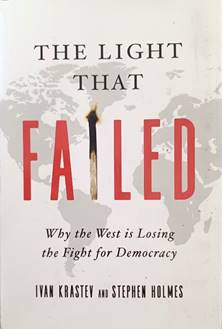
While some important West-European countries have for some time now trying to stave off challenges from right-wing populists (France, Germany, with Italy already having a “post-Fascist” prime minister), this text returns to the post-Cold War period and its political repercussions. The three chapters of the book are about East-Central Europe, Russia, and the USA. The third chapter is especially pertinent because at the time of writing this summary (November 2023), it looks as if Donald Trump will run for president again, with a real possibility of beating Joe Biden. The authors’ treatment of Trump’s electoral basis aligns well with another summary in this series, Angus Deaton, Economics in America: An Immigrant Economist Explores the Land of Inequality. Princeton University Press, 2023.
Krastev, an important public intellectual in Eastern Europe, and Holmes, an academic expert on and proponent of liberalism, acknowledge that, “Most of us have trouble imagining a future, even in the West, that remains securely democratic and liberal” (p. 1).
East-Central Europe
As for East-Central Europe, the “political elites in the region were almost universally enthusiastic about the imitation of Western European and American ‘normality.’” Yet, with the passing of time, arose “hostility to imitating the West,” which became a “key theme of the populist revolt” (all on p. 45). One must also keep in mind that, after 1989, the Western-European model of liberal democracy (and its practice) did not remain static, making an imitation approach a constant process of trying to catch up. Moreover, putting the words “liberal” and “democracy” together is problematic since liberalism is a universalist political ideology, while democracy can only be realized in the context of a national political system (p. 58). As a result, “While the liberal elites continued talking the language of universal rights, their nationalist counterparts eventually took control of the national symbols and national narratives” (p. 57).
All this is not exactly what many observers had anticipated when the Cold War ended. There was high “hopes for liberal capitalist democracy spreading globally” (p. 1). In retrospect, these observers “prematurely celebrated the integration of the East into the West” (ibid.). Krastev and Holmes admit, “The illusion that the end of the Cold War was the beginning of an Age of Liberalism and Democracy was our illusion too” (p. 3).
To a good extent, this illusion resulted from the fact that, after the breakdown of Marxism-Leninism, only liberal democracy seemed to be a viable model for organizing a political order. And since there were countries in the West that had realized this model in the decades prior already, the task of the newly emerging countries of the East simply seemed to imitate that model. This lack of other options, the authors think, “best explains the anti-Western ethos dominating post-communist societies today,” and not an intrinsic preference for authoritarianism nor any historically determined rejection of liberalism (p. 5). It was the wholesale imitation of the Western model required of them, rather than merely a selective borrowing, that eventually turned the elites and their followers against the West. This is so because such borrowing “does not affect identity,” only tools or means, but not “moral ends” (p. 8f.).Importantly, the national elites could argue that elections had become meaningless because the EU would enforce policy continuity. This “allowed aspiring populists to claim exclusive ownership of national traditions and national identity” (p. 22).
At the same time, the national constructs came under threat through the decisions of the younger generations. Impatient with the slow pace of political reforms and economic development, and enjoying freedom of movement within the EU, many of them migrated to those countries where they saw better opportunities to pursue their personal goals. In turn, however, this awakened “fears of national disappearance” (p. 38). Krastev and Holmes liken this to the situation after World War II when the Soviet-supported German Democratic Republic faced massive out-migration to the Western part of Germany and eventually reacted with the construction of the wall. In short, illiberalism in East-Central Europe is motivated by the notion of national identity, against individualism and cosmopolitanism, rather than by a rejection of multiculturalism. The “anti-liberal consensus today is that the rights of the threatened white Christian majority are in mortal danger” (p. 43).
Russia
The Soviet Union disappeared from world politics on 1 January 1992, very much to the surprise of its people and observers alike. With this disappearance, the ideological model that had underpinned it vanquished. Krastev and Holmes try to shed light on the fact that the remains did not join “the Western-dominated world order” (p. 78). Rather, Putin’s Russia became “an angry revisionist power, seemingly focused on destroying the European order” (ibid.). For a time in the 1990s, the Russian leaders tried to “simulate” (p. 79) the Western model. With Putin’s ascension to power, however, this changed. An even “more radical break” occurred in 2011-12 (p. 79). “At around that time …, the Kremlin shifted to a strategy of selective mirroring or violent parody of Western foreign policy behavior … to erode the normative foundations of the American-led liberal world order” (ibid., italics in the original). “We are still in this third phase today” (ibid.). One might say that Russia’s war against the Ukraine is based on precisely this mindset. In this context, “The Crimean annexation was, fundamentally, a bid to re-legitimize a system that was losing its credibility. It did this by demonstrating that Moscow could defy the West with impunity” (p. 112).
The watershed was marked by Putin’s aggressive speech at the Munich Security Conference in 2007. “Putin’s belligerent speech was like a declaration of war. It was a scathing assault on the global security architecture crafted by the Western powers … He denounced NATO expansion as an act of betrayal, citing verbatim one long-forgotten official promise that such eastward encroachment would never be allowed to happen” (p. 80). He turned against America’s leadership claim and denounced the demand that all countries “were morally obliged to adopt the ‘international human rights norms’ of the West” (p. 81). Putting rejected the “Age of Western Hypocrisy” and criticized that “universalism was the particularism of the West” (ibid.). “What the West celebrated as popular democratic revolutions were simply Western-sponsored coups d’état” (ibid.). Putin replaced the West’s “celebratory storyline” by making the winners of the Cold War listen to the losers (p. 82). “Putin informed his Western counterparts that Russia was determined to destroy the post-Cold War liberal order” (p. 83).
The authors point to an important difference: The end of communism and the end of the Soviet Union were not perceived as being one and the same by the people. Support for the former was compatible with regret for the latter. One question, thus, is what should have replaced the communist order. At the beginning, Russia did proceed to build “Potemkin replicas of Western institutions” (p. 91), for example, a constitutional court or elections. These institutions could even be used to “mask and preserve the autonomy of a political ruling class” (p. 92). The question, then, was, “Would stimulating democracy help democratize Russia or, instead, help perpetuate Russian authoritarianism and Russian oligarchy” (p. 92). From the perspective of the people, these were not necessarily contradictory political orders. In an opinion poll conducted in 1996, voters wanted a combination of both: a strong state with respect for its citizens and their private lives (p. 98). As for the democracy part, the blatant rigging of elections played an important part (pp. 99-106). “Democracy” became a political technology, “a non-violent strategy for sustaining elite rule” (p. 107).
From the beginning of Putin’s rule, a course of preventing Western cultural influences from reaching the domestic population was a key policy approach (p. 118). Supporting Russian nationalism complemented this goal, to the point of “aggressive isolationism” (p. 119). However, this did not always work, particularly with the elite’s own foreign-educated children. “Thus, the charge that the West is stealing the children of Russian elites is one of the principal tenets of Kremlin anti-Westernism, driving its attempts to repatriate the country’s foreign-domiciled business-class” (p. 121f.).
In conclusion, “Russia’s policy of ironic mimicry and reverse engineering of American hypocrisy may be slowly nudging the world towards disaster. Aggressive imitation assumes … that all grounds for trust between Russia and the West have been fatally eroded” (p. 135). With Russia’s unprovoked war against the Ukraine and the West’s collective response to it, there does indeed seem to be no more trust left in their relationship, certainly if Putin remains in power. In this situation, the prospect of “disaster” has increasingly become a serious concern for Western policymakers, political observers, and the European population.
USA
At the beginning of this third chapter, Krastev and Holmes ask,
Why have substantial swathes of the American public and the US business community as well as most Republican leaders aligned themselves uncritically with the project of dismantling what the neoconservative historian Robert Kagan, with good reason, has called ‘the world America made’? (p. 138f)
Even in 2023, this remains a pertinent question, given that the US Republicans are still dominated by Donald Trump, and he will probably run again in the 2024 presidential election against 80-year-old Joe Biden, with a realistic chance of beating him. The authors add the question, “how [do] his [Trump’s] supporters view the rest of the world?” (p. 139). Why is there this resentment towards the rest of the world; “why would the imitated resent their imitators?” (ibid). Why do they feel that the USA have suffered “decades of humiliation” (ibid.), thereby, one might add, producing the need for “MAGA” (Make America Great Again)? Donald Trump needs to be seen “in the context of a contemporaneous worldwide revolt against liberal democracy and liberal internationalism” (p. 140), the triumph of “provincial resentment against a cosmopolitan world” (p. 141f.).
From Trump’s perspective, three key elements of the US’ previous foreign relations approach do not hold any longer: that it must spread its political model abroad; that the US has a historical mission; that Americans must spread liberty, justice and humanity everywhere. Rather, he “persistently rejects America’s messianic self-understanding” (p. 145). But why was there so little resistance to Trump’s approach? Why were Americans prepared to accept political views so radically dissonant with many of their country’s deepest cultural traditions?” (p. 149). One reason is the acceptance of America’s decline of influence. That made it rational for voters to elect a candidate who denounced any attempts of foreign democracy promotion. Ironically, the end of the Cold War also deprived the US of its ideological core, its public philosophy. “Democracy and human rights began to seem less central to the nation’s identity” (p. 152). Moreover, the great majority of Americans have little idea about the world in which their nation must act as an international policy leader. At the same time, the foreign imitators of the American lifestyle have become competitors, both economically and geo-strategically, making the concentration on increasing one’s own strengths rational. And this must include positioning the US against other countries. “America’s brand, and brands, will never come out first so long as other countries free-ride on American ingenuity” (p. 161).
As for the voters, they are suffering from “existential anxieties” (p. 163). Globalization takes jobs away, brings more immigrants to the country and its labor market, and this affects a “loss of identity” (p. 164), a destruction of their white “imagined community” (p. 165). From this perspective, “Trump has capitalized on a cultural shift, most prominent in provincial America, away from an open and welcoming to a closed and unwelcoming definition of ‘who we are’” (p. 166). This is underpinned by the economic and social struggle of working-class and lower middle-class families in the United States. Thus, this broad stratum of the US population provides fertile electoral ground for “populist demagogues” (p. 167). The end of the Cold War was felt by this stratum too: “Without a formidable communist enemy, American capitalism abandoned what little concern it had for the well-being of working stiffs and wholeheartedly embraced an essentially unlimited concentration of wealth at the top” (p. 168). To the “new plutocracy’s ‘forgotten man’, it began to feel like a post-Cold War defeat” (ibid.): economic disparities grew, social mobility sank. What happened was a “dangerous untethering of the American establishment from the bulk of the population (the authors refer to the 1995 book The Revolt of the Elites, by Christopher Lasch). Consequently, “a populist counter-elite willing to listen” (ibid.) to types like Trump emerged. Liberalism is far from their concerns. Of course, Krastev and Holmes do not miss to refer to the “meritocratic value hierarchy” (which occurs to this stratum as the “tyranny of meritocracy,” blaming them for their lack of advancement in the socio-economic realm) (p. 170). In this context, the authenticity of anti-liberal elites is more important to the voters than whether what they say is truthful or not. Loyalty is the name of the game, not accuracy (p. 177). This way, Trump “has turned the Republic of the Citizens into a Republic of Fans” (p. 178). This comes with the “repudiating [of] the very idea of deliberative politics at the heart of liberal democracy” (p. 179). One could argue that, in theory, liberal democracy might be based on political deliberation. However, and this, in fact, is implied in what the authors say, when the concrete political structures are designed in a way far removed from ideals of liberal democracy, then proponents of liberal democracy should not be surprised when their political model is not taken seriously by precisely those people whom their ideal political order is supposed to serve.
The book concludes with a few remarks on the ascent of China and the fear “that a Sino-centric world will be populated by Chinese-style authoritarian, amoral and mercantilist regimes” (p. 195). Besides goods, China may export “universally exportable illiberal authoritarianism” (ibid.), though Xi’s approach seems to be more totalitarian than authoritarian, one may say. The Chinese under Xi aim to “‘de-Americanize’ the world” (p. 197), not only domestically, but also with respect to the international order. Nevertheless, China is not intent on recruiting imitators but to increase its “global influence and global recognition” (p. 201). What China teaches the world is, “The copious benefits of rejecting Western norms and institutions while selectively adopting Western technology and even consumption patterns” (p. 202). All this points to the end of the “Age of Imitation,” because Xi sees the future of global competition with America through purely military and strategic lenses, without regard to ideology or visions of mankind’s shared future” (p. 203). In this sense, the result is “a pluralistic and competitive world, where no centers of military and economic power will strive to spread their own systems of values across the globe” (p. 204f.). To liberals, the task ahead will be to figure out a way of how to deal with this new situation—that the “globally dominant order” (p. 205) is gone for good, and nothing will bring it back.
The setting of the story is an isolated hamlet of three houses and a stable for cows in the French countryside. However, most of the story unfolds in the kitchen/dining room of the main house. Readers used to stories that are driven by a mix of narrative and extensive dialogues among the protagonists will have to adjust their expectations to a novel that does almost entirely do without dialogues or even verbal statements. This text rather requires readers who are perhaps unusually patient since typical pages look like the ones shown in the picture on the next page.
The main cast of characters includes seven people.
Patrice Bergogne, in his early 50s. He is the owner of the hamlet, a farmer raising cows, for which he needs the stable.
Marion, his wife. After finishing occupational school, she now works as clerical staff in a small print shop in town. It is her fortieth birthday that is planned to be celebrated.
Ida, their ten-year old daughter.
Christine, or, as she is affectionally called by Ida, Tatie. She takes care of Ida after she returns from school, and before her parents return from work. She is “a Parisian artist [painter], exuberant and batty” (p. 13). She has become old and dislikes the comments her paintings generated in Paris. So, she rented a house from Bergogne, whom she had known since he was a child.
Three brothers, with the key figure being Denis, helped by Christophe and Stutter, the youngest, who used to spend some time in a psychiatric hospital.
The “Birthday Party” is being arranged by Patrice, Ida, and Christine for the fortieth anniversary of Marion. Patrice had met Marion about ten years earlier on the Internet. “He had believed when he met Marion that it would be impossible between them, wondering how she could fail to see they had nothing in common … wondering how she could even think of being interested in him” (p. 81). In fact, by the time of her fortieth birthday, their marriage had become inactive. They would barely talk to each other, and Patrice’s sexual needs had become so unfulfilled that, on the day of Marion’s birthday, while being in town to buy a computer as a gift for her, Patrice still managed to fit in a quicky with a prostitute. It made him feel guilty, but the need prevailed.
Before Marion returns home from her work to celebrate her birthday, three men turn up at Bergogne’s house. Christine’s dog does not bark, because Stutter had stabbed him to death in the stable. He is assigned by Christophe to keep an eye on Christine in her house. After all, what would follow has nothing to do with her. Denis and Christophe later impose their presence on Patrice while waiting for Marion’s return. Patrice is speechless about what happens: “Who are you? … What’s going on here?” (p. 173). He has absolutely no clue about what is happening to him in his own house. Essentially, he, Ida, and Christine are taken prisoners by people who they do not know, and whose purpose of doing so remains entirely in the dark.
On p. 237, Marion is still driving home in her car, singing loudly to the music coming from the radio. When she eventually drives up in the courtyard, she wonders about the unknown cars that are parked there. Upon entering the house and seeing Denis and Christophe, Patrice sees “Marion’s body frozen, Marion’s collapse, Marion’s death in her expression, her movements, as though everything has stopped – and everything stops for her for a fraction of a second, her face locked on Denis’s, Christophe’s … Patrice sees all this and it’s as though he understands everything, everything is resisting him but he understands, through Marion’s face and the collapse …” (p. 241).
What happens is that Marion’s past, roughly 30 years before she got to know Patrice (with Ida as her infant daughter), a past she had not agreed to talk about with her husband, catches up with her. Marion had been willing “for all those years playing the idea of a couple rather than being a couple” (p. 293) in exchange for an escape from her past, especially from Denis, who had spent ten years in jail for a murder in which Marion played an important part. When he went to jail, Marion (already pregnant with Ida) took the opportunity to leave this toxic relationship behind her by putting as much geographical distance between her previous life and what was to become her future life. It was only by an unforeseeable chance that an acquaintance of Denis came across Marion in a karaoke club, without letting her know that he had recognized her. He told Denis, who carefully started, helped by his brothers, to ambush the family on Marion’s 40th birthday. Denis wants to humiliate her, to destroy even that “idea of a couple,” he wants to punish her for fleeing while he rotted in jail. But most of all, he wants Ida, his daughter.
From p. 459, the time for the final showdown had arrived.
But also soon, the gunshots.
Soon death will come knocking at the hamlet just as it comes knocking everywhere, for it is at home everywhere, at home when it wants to be, making itself comfortable in apartments where it’s never set foot or even deigned to cast an eye …
Soon: seven shots ringing out in the emptiness of the night, four of which will hit their target, the others getting lost somewhere in a piece of furniture or a wall.
One reviewer called what followed a “bloodbath.” My impression rather was that of an old-style final gunfight in a dusty Western cowboy town (such as Tombstone) with the good guys facing the decisive battle with the bad guys, in which the good guys emerge victorious, but not unscathed. Police and firefighters are about to enter the courtyard when a final fateful twist produces the conclusive bullet that puts an end to this showdown.
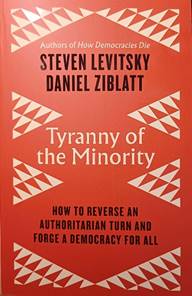
The authors of this book share Heather Cox Richardson’s view that the political system of the United States of America is at the “crossroads.” They could have added the subtitle of Richardson’s book, “Notes on the state of America.” Except for a few comparative references, the text is entirely about the US political system. Levitsky and Ziblatt have a more academic approach, and readers can learn much about US constitutional and political history. Their book can almost be read as a focused primer about such issues. In doing so, the authors’ basic approach is simple: The meaning of democracy is that, after free and fair elections, those who received majority support must be able to govern. This may sound like a truism, but their key point is that, in present-day America, it is the minority that dominates the majority. A “radicalized partisan minority” represented by the Republican Party has been subjecting the majority to its will, and constitutional “institutions [exist] that protect and empower it” (p. 257), which Levitsky and Ziblatt often refer to as “counter-majoritarian institutions.” While other democratic countries around the world have, over the years, adapted their institutions to changed societal conditions, needs, and ideas, the USA has not. From being a model to be emulated by democratizing countries, the USA have become a “laggard” (p. 216) and an “outlier” (p. 198).
Among the key “counter-majoritarian institutions” are:
A Supreme Court whose judges enjoy lifetime appointments, which means that a generational gap opens between them and the majority of the population, and this usually includes a gap regarding values and norms.
Federalism, which means that many areas of lawmaking are not accessible to national majorities.
“A severely malapportioned Senate,” in which all states have two members, independent of the size of the respective states’ population number.
“The filibuster, a supermajority rule in the Senate (not in the Constitutions) that allows a partisan minority to permanently block legislation backed by the majority” [in the House]. The authors mention that, at earlier times, a filibuster had to take place physically in the chamber, while, presently, any Senator could just register his or her intention to filibuster, thereby basically making such an exercise having no cost at all. And since there is a high hurdle for ending debate and coming to a vote (three-fifth of its members), a filibuster means that any legal measure adopted by the House could die in the Senate. “As filibustering became costless, what had once been rare became a routine practice,” p. 163). Regarding the cloture aspect, the authors note, “America thus entered the twenty-first century with a ‘sixty-vote Senate’.” (p. 216)
The indirect election of the president via an Electoral College. Here, smaller states have an advantage, and presidents can be elected by a majority of electors in the College without having gained the majority of the public vote. [The most infamous example perhaps being that, in 2016, Hilary Clinton gained 2.8 million more votes than Donald Trump. Nevertheless, the loser—Donald Trump—became president, while the winner—Hilary Clinton—became the loser.]
“Extreme supermajority rules for constitutional change: a two-thirds vote of each House of Congress, plus approval by three-quarters of U.S. states.” (adapted from p. 148).
“America also retained its first-past-the-post electoral system,” which could, especially in state legislatures lead to minorities dominating majorities. “The United States thus joined Canada and the U.K. as the only rich Western democracies not to adopt more proportional election rules in the twentieth century.” (p. 215)
Eventually, the authors arrive at the point where they need to suggest what changes they think were needed to create a “truly multiracial democracy” (p. 258). Chapter 8, thus, is about “Democratizing Our Democracy” (pp. 225-258). Looking to the immediate future, they note, “The conditions that gave rise to the Trump presidency—a radicalized party empowered by a pre-democratic constitution—remain in place” (p. 225). [Levitsky and Ziblatt do not say much about the very basis of the radicalized Republican Party, by which I mean the radicalized electorate. Its existence is not Trump’s achievement, but, as they point out elsewhere in the book, he was very good at addressing those voters’ grievances and values.]
On pp. 230 to 236, Levitsky and Ziblatt summarize their proposals under three headings:
UPHOLD THE RIGHT TO VOTE
The right to vote should become a constitutional right, “which would provide a solid basis to litigate voting restrictions.”
When American citizens turn 18, they should automatically be registered as voters. [Hard to believe as it may seem, but the US leaves voter registration to the voters themselves, rather than establishing automatic voter rolls.]
Early voting and mail-in voting should be expanded.
Voting should take place on a Sunday or a holiday, “so that work responsibilities do not discourage Americans from voting.”
Ex-felons should be allowed to vote.
“Restore national-level voting rights protections,” This should apply to all jurisdictions, not only to those suspected of foul play.
Partisan electoral administration should be replaced by elections that are administered by professional officials.
ENSURE THAT ELECTION OUTCOMES REFLECT MAJORITY PREFERENCES
The authors introduce this section by stating the obvious [which is not that obvious in the US context]: “Those who win the most votes should win elections. Nothing in democratic theory justifies allowing losers to win elections.” (p. 233)
“Abolish the Electoral College and replace it with a national popular vote.” (p. 233)
“Reform the Senate so that the number of senators elected per state is more proportional to the population of each state…” (p. 233)
“Replace ‘first-past-the-post’ electoral rules and single-member districts for the House of Representatives and state legislatures with a form of proportional representation…” (p. 234)
“Eliminate partisan gerrymandering via the creation of independent redistricting commissions such as those used in California, Colorado, and Michigan.” (p. 234)
The Apportionment Act of 1929 fixes the number of members of the House at 435. This does not take into account population growth making the proportion of one representative to voters extremely high. Increasing the number of House members could also serve to bring the representatives closer to the people.
EMPOWER GOVERNING MAJORITIES
The filibuster must be abolished, because minorities should not be able to permanently block legislation that the majority wants to pass.
Supreme Court judges should lose their lifetime appointments (they suggest 12 or 18 years). Every president should have the opportunity to appoint the same number of judges. “This would also limit the court’s intergenerational counter-majoritarianism.” (p. 235)
Constitutional amendments should be made easier by eliminating the requirement that three quarters of states must ratify them. Instead, two-third majorities in House and Senate should be sufficient.
“These reforms we propose might appear radical, but they are already in place in the vast majority of established democracies…” (p. 236)
Levitsky and Ziblatt, of course, realize that achieving these changes will not at all be easy. To them, they serve as issues to be put on the agenda and be kept there for as long as it takes. But it is not only an agenda issue. Equally important, perhaps even more so, is the issue of mobilization. They stress that all major changes, from Woodrow Wilson to Franklin Delano Roosevelt, and Lyndon Johnson, were preceded by long-lasting social movements. “What is needed today, then, is not only a democratic reform agenda but a democratic reform movement capable of mobilizing diverse citizens in a sustained nationwide campaign to ignite imaginations and change the terms of public debate.” (p. 249 f, original italics) The authors see partial movements such as Black Lives Matter and pro-democratic movements during the Trump presidency as examples. They also mention Protect Democracy (founded in 2016), and Gen-Z for Change. There are even Republican voters who mobilize against Trump, such as Republican Voters Against Trump or Republicans for the Rule of Law.
In short: “Defending democracy is tiring work.” (p. 256)
In the final paragraph, the author writes, “This was an only-in-America story of glorious accomplishments and unfinished business, made possible by the broader political and economic currents that shaped more than half a century of history” (p. 411).
First, obviously, there is some hyperbole in this statement, though few would doubt that our everyday lives would look much different without personal computers, digitized word processing, the Internet, social media, mobile phones, or online shopping. This goes just as much beyond the “remaking of America” as did the invention of the wheel, printing, electricity or of the invention of personalized mass transportation. One does not necessarily need to connect this to certain well-known company names, such as Apple, Microsoft, Meta (Facebook), Alphabet (Google), or Amazon, because these companies did not normally invent those things at which they have become so immensely successful (and super rich). Rather, they are based on the optimization of preexisting inventions (anyone remembers Netscape or WordPerfect?), supported by venture capitalists and their managerial support (after all, the founders of the above companies were quite young). And the next “big thing” is already making strong waves, both in terms of enthusiastic anticipation and regarding worries about what will happen to humankind: Artificial Intelligence (AI).
Second, O’ Mara could have approached her theme from an academic-analytical perspective by systematically outlining the “broader political and economic currents,” and then locate the actors in this context, showing the interaction of context and action during the various periods that she covers. However, though there certainly are references to those context variables, her basic approach rather is a historical narrative that puts the actors first. Thus, there is a lot of name-dropping in the book, and she seems to aim for a writing style that she might have thought of as “cool,” but which sometimes got on my nerves. Thus, the book can be read as some kind of series of newspaper feature stories about roughly the past fifty years on what tech development has taken place in Silicon Valley, at Stanford University, but also in Seattle.
To put her narrative in a proper frame, O’Mara notes on p. 20:
It began with the bomb. To scientists and politicians alike, the technological mobilization of World War II—and its awesome and ominous centerpiece, the Manhattan Project [located at Los Alamos to create the first atomic bomb dropped on Hiroshima and Nagasaki, led by J. Robert Oppenheimer, MN]—showed how much the United States could accomplish with massive government investment in high technology and in the men who made it. … [the project] also catalyzed development of sophisticated electronic communications networks and the first all-digital computer-technologies that undergirded the information age to come.
Thus, the context of what was to happen later was a trinity: science—government money [be it from the military or NASA, MN]—scientists. Yet, this trinity occurred in a particular geopolitical situation, the Cold War, and the competition with the Soviet Union. The electronics industry became ever more important, especially after President Eisenhower and Secretary of State John Foster Dulles moved from a ground troop and conventional arms conception of warfare to advanced electronics in 1953.
In the mid-1950s, two students at Stanford University [that was to become a center for electrical engineering and computer science], supported by their mentor, Fred Terman, founded a company in what was then merely called Santa Clara Valley: Bill Hewlett and Dave Packard [who later became an influential Republican]. At that time, semiconductors were still in their early stage of development. William Shockley, one of the scientists who invented the transistors and who established the company Shockley Semiconductors was instrumental in this, but some members of his staff thought that he was going about this in the wrong way. Those members left his company and established Fairchild Semiconductor. They included Robert Noyce, Jay Last, Gordon Moore (“Moore’s Law”), among others. “Modern Silicon Valley” (p. 41) started with this company. Noyce and Moore moved on to found Intel, together with Andy Grove, who came to the US as a teenage refugee from Hungary.
In “early 1959, Jean Hoerni discovered a way to place multiple transistors on a single silicon wafer,” allowing “Bob Noyce to experiment with linking the transistors together, creating an integrated circuit … more powerful than any device before it” (p. 50). In fact, at Texas Instruments, Jack Kilby had the same idea almost simultaneously. However, he used germanium instead of silicon. Noyce filed his patent in 1961. Eventually, silicon gained the upper hand, because it was easier to use in the production of semiconductors (or “chips”).
In the early 1970s, chips were devised that went beyond their initial memory function. They became “programmable” (p. 102, italics in the original). This kind of chips were called “microprocessors.” First on the market was Intel with its 4004 in 1971, followed by the 8008 and, in 1974, the 8080, each of them much more powerful than its predecessor. Jerry Sanders of Advanced Micro Devices (AMD) gets several mentions. Their appearance made computers ever smaller, a far cry from the earlier huge IBM-manufactured mainframe computers that dominated the market [at that time, input was still by punch cards, pointing to considerations regarding the human-computer interface, MN]. They also made computers more affordable, leading to “microcomputers” that included a widely used precursor of the “cloud,” namely time sharing among users. Developers did not have to own a computer to do their work; they could simply rent computation time on such a microcomputer.
By 1975, Intel already had 3,200 employees, while Steve Wozniak and Steve Jobs were still garage-based computer nerds. In 1977, the Apple II appeared on the scene. A little earlier, William Gates and Paul Allen had met while still being schoolchildren using the computer facilities at the University of Washington. In 1973, Gates moved to Harvard University for his freshman year. Allen also moved to Boston to work at Honeywell. Perhaps one should keep in mind here that, at this point in the computer’s history, these devices were still new, and their use was limited to very small circles of people. The idea that such exotic machines could at some time in the future become mass consumer products—be it as a personal computer, laptop, tablet, or a mobile phone—that most people could not live without in managing their daily lives still did not exist as a realistic expectation.
That this nevertheless happened was not only achieved by the existence of hardware. Rather, the “ultimate disruptor” (p. 239) was the software that enabled computers to fulfil a multitude of tasks. Most importantly, Microsoft’s MS-DOS operating system was unlinked from a specific brand of hardware (as was the approach chosen by Apple). Rather, it could be used on all brands. Consequently, it “rapidly became the industry standard” (ibid.; readers should keep in mind that all these developments required capital, patents, competition, and business practices that some would call “hard-nosed,” if not something worse than that). Thereby, the IBM PC (personal computer) became ubiquitous in the form of “clones.” Yet, these clones were still mostly isolated machines; they were not connected among each other. This most important phenomenon of interconnected computer networks became known as the World Wide Web, or the Internet. However, it did not just drop from the sky as a finished product. As in most other cases mentioned here, it was based on a process of improvement and changing context conditions that led to a new tool. O’Mara writes, “It was more than thirty years old by the start of the 1990s, and it still had the academic and proudly noncommercial spirit it started with in 1969” (p. 287). For many years, the WWW depended on dial-up networks via modems and telephone lines. Bandwidth was very limited. In the early 1990s, “97 percent of Americans had no connection to the Internet” (p. 301).
Yet, the content stored on computers that were connected via the Internet increased considerably over the years. There needed to be a way of knowing what content existed and where users could find it. In 1993, the Internet browser Mosaic was introduced. It “turned the Internet into an immersive, colorful, point-and-click experience” (p. 305). Its chief inventor was Marc Andreessen, helped by venture capitalist John Doerr. Soon, the company was renamed Netscape. Later, Yahoo! appeared on the scene. These companies needed advertising to make money. Still, the Internet was largely about searching for information, not for using it for business transactions, which, obviously, would also require the development of secure online payment systems. Jeff Bezos’ Amazon came into being as an online bookseller in 1995, again with John Doerr’s help. This connection of ideas to capital and management expertise was also vital for a pair of innovators who improved the method of searching for information to an extent that the competition soon disappeared, Sergey Brin and Larry Page, the two co-founders of Google, while they were still PhD students at Stanford University. Interestingly, they were among the first who moved into the William H. Gates Computer Science Building that Bill Gates had donated to the university. In the year 2000, Google’s number of employees was just 60. In building its search engine, Google followed an approach used by Overture, meaning that one would not see advertisement banners on one’s screen. Rather, each search generated information for Google and its advertising customers, enabling them to better target their advertisements. Google grew by leaps and bounds, and in 2004, the company went public, making all involved (not least the early investors who had received shares in return for their money) immensely rich. O’Mara quotes one coder, who had remarked, “You’re not the customer. You’re the commodity” (p. 361f.).
The “next big thing” occurred in the same years that Google had its IPO: Facebook, founded by Marc Zuckerberg while still studying at Harvard University. The author speculates:
Facebook and other social networks also filled a cultural void created by a half century of political liberation and economic dislocation, the vanishing, the vanishing of the bowling leagues and church picnics and union meetings that had glued together midcentury America in conformity and community. Social media became a more cosmopolitan town square, one that crossed national borders, launched new voices, and created moments of joyous connection that could morph into real-life friendships. (p. 372)
[To me, Facebook was useful for several years since Thailand’s military coup in 2014. After a while, however, the share of advertisements had increased unacceptable to me, the feed was hardly relevant, and there was very little social communication among active members, who were but a tiny fraction of those listed as my “friends.” And no Facebook “friendship” ever evolved into a “real-life friendship,” neither was the experience “cosmopolitan.” Thus, in the end, I deleted my account entirely. MN]
Of course, both Facebook and Twitter are mentioned as potential tool for political mobilization, from the Arab Spring and Occupy Wall Street to Black Lives Matter and Barack Obama’s presidential election campaign.
O’Mara’s book breaks off in 2018. She tries to end it with a perspective that starkly contrasts with the big money-making machine that high-tech has become. People in the field of computer science, she suggests, are nowadays not merely in this field for career and money, but rather look for work-life balance and the creation of a personal vision about what they would like to do with their lives. Yet, this merely is a feel-good paragraph without analytical substantiation. Readers should keep in mind that this book is a historical narrative about a certain valley in California and the question what went on there that irreversibly changed the way people go about their economic, social, and political lives in this world, and not merely in this valley. This book is not a social science analysis about the origin, effects, problems, solutions, and the future of high tech, be it self-driving cars or KI.
Margot Friedlander lived in Nazi Berlin with her mother and younger brother. It is January 20, 1943. By that time, many Jews, including some of her family and her father, had already fled Germany. The frequency of deportations to a mythical ‘East’ from which no one ever returned had increased. Living conditions had become increasingly restrictive. Since 1941, when they went out in public, they had to wear the ‘Star of David’ on their cloth to mark them as Jews. They could not sit on a bench in the park, swim in a public pool, go to the movies, or use public transportation. Jewish professionals lost their jobs. Margot’s father was a gynecologist. He was only allowed to treat Jewish patients. Margot’s brother could not go to the gymnasium because it was reserved for ‘Aryan’ Germans. Margot notes, “As 1935 progressed, the mood in Berlin became more and more depressing. We heard of arrests all the time. We passed shop windows with the words ‘Don’t buy from Jews.’” On the night of November 9-10, 1938, the Nazis organized massive violence against Jewish owned businesses and synagogues. German Jews, who felt like Germans, were unsure how far the Germans would go in oppressing them. After all, the Germans were supposed to be ‘civilized’ people who shared a culture to which the Jews had made enormous contributions. Moreover, the Germans would surely eventually stand up to the Nazis and help the Jews. Margot: “Now we saw that no one would help us. They had even cheered when the synagogues burned.” Moreover, precisely because they felt a sense of belonging to this country, many found it hard to accept the idea that for their own protection they would have to leave behind what generations had created.
Margot’s mother could not cope with the situation. In fact, friends came to visit her in Berlin and tried to take her immediately to a police camp in East Germany. It was supposed to be a safe place, and it indeed was since everyone who had been there had survived. But she wanted to wait a little longer. Eventually she agreed to join them in a few weeks. Preparations for her move were made in secret. On January 20, 1943, a final preparatory meeting was scheduled in her apartment. Margot was walking along the sidewalk toward the entrance when she noticed an unknown man entering. As she climbed the stairs, she saw him standing with his back to the door of her apartment. She walked past him and rang the doorbell of the apartment one floor above hers. The owner told her that the Gestapo had taken away several people, including her younger brother. Thus, her mother was still free. Therefore, Margot went to a friend’s house, where her mother was supposed to wait. But she arrived too late. Her mother had already gone to the Gestapo to join her son. Before she left, she had asked that Margot receive this verbal instruction: “Try to make your life.” There was no written note. But Margot was given her handbag with an address book and her amber necklace. She never saw her mother or younger brother again. They were both murdered upon arrival at Auschwitz.
Margot was able to stay with friends for a few days. But she had to decide what to do. She had her mother’s address book. In it, she had collected the names of all the people who might be able to help them. In the end, Margot decided to go underground. She took off her ‘Da-vidstern,’ dyed her hair red, and even found a way to have her nose surgically altered. From now on she lived for days, weeks, sometimes months with people she did not know but who were willing to help her. She continued this life for 15 months, until April 1944. During this time there were many air raids. Margot could not seek shelter where she lived because other people in the house would have wondered who she was. Instead, she used a public air-raid shelter. On one such occasion, she had stayed in such a shelter with two friends. On their way home, two men stopped them and asked for identification. Of course, Margot had no identification. It turned out that the two men were “Greifer,” Jews who hunted down other Jews living underground to hand them over to the Gestapo. They saw this as their way of protecting their own families and themselves from deportation. Margot admitted that she was Jewish.
At the transit camp in Berlin, Margot realized that she had only two options. Either she was sent ‘to the East’ or to the Theresienstadt ghetto. “Those were the two ways we could leave this transit camp. We knew nothing about the East. We heard more about Theresienstadt.” Many well-known Jews were sent there. At the end of May 1944, another transport was organized to go there. But there were only 23 people on the list. Margot’s name was not on it. She had made the acquaintance of a man who worked in the camp administration and who had promised to help her. So, she approached him with her wish to be included in this transport. He was able to arrange it for her. In the book, her time in Theresienstadt begins on page 178.
On or about April 20, 1945, a train with many cattle cars pulled into the station. The doors opened and people who no longer looked human fell out of the wagons, many of them dead. These people came from Auschwitz. Before that extermination camp was liberated on January 27, 1945, the SS guards had sent these people on the infamous ‘death march.’ They had walked for nearly three months. Those who survived were put in cattle cars and sent to Theresienstadt. Margot writes: “At that moment, the ‘East’ became associated with a name [Auschwitz]. It was at this moment that we learned of the existence of the death camps. And at that moment I realized that I would never see my mother and my brother again.”
Soon after, Russian troops liberated Theresienstadt. Margot and her future husband tried to adjust to the new circumstances. On June 30, 1945, her husband, Adolf Friedländer, received a telegram from his sister, Ilse, who lived in New York. In July 1946, Margot and her husband were on a ship that would take them to New York. She ends her memoir on a bitter note, wondering if the Statue of Liberty, which the ship had passed, really symbolized freedom. After all, when they desperately needed help to escape Germany, the U.S. had erected bureaucratic hurdles they could not overcome. “If I had been standing here eight years earlier with my mother and brother, I might have been happy.”
This book is neither an academic monograph nor a novel, or a biography. Rather, it is the story of the Jewish community (Juderia) on the Italian (now Greek) island of Rhodes, that had existed there for ages until it was destroyed by the German occupation forces in July 1944. The Jewish community in Rhodes were Judeo-Spanish-speaking Sephardic Italian Jews, who referred to themselves as Rhodeslis. On 23 July 1944, its 1,700 members were transported to the port of Piraeus, passed through the prison of Haidari, and ended up in the Nazi’s Auschwitz extermination camp. Most of the community’s members were murdered. One of the very few survivors was Stella Levi. She was 92 years old when writer Michael Frank met her at Casa Italiana of the Department of Italian Studies at New York University in February 2015. Over the next six years, the author would spend “100 Saturdays” talking with Stella about her childhood, her youth, the everyday life in the Juderia, and about her survival in Auschwitz. This book is the result of this series of talks. It is a vivid and moving testament to life in the Juderia.
At first, Stella does not want to talk about the issue of Auschwitz. Why not?
“Because I don’t want to be that person.”
She has never wanted to be a performing survivor, a storyteller of the Holocaust, ossified, with no new thoughts pr perspectives, or with this event placed so central, too central, in a long, layered life. (p. 8)
Rhodes became Italian, first, in 1912 because of the Italo-Turkish war, and again in 1923 with the Second Treaty of Lausanne. In fact, since ancient times, Italy had no connection to the Island. Then, it became part of Italy’s attempt to emulate other European nations in having colonies, which would lead them to Libya and Ethiopia. With the Italians came improvements of the island’s infrastructure and modern health care. Afterwards, in 1938, however, the Italians followed the example of Nazi Germany by promulgating racial laws.
Under the racial laws her [Stella’s] father was constrained to sell his wood and coal business to a new—Italian—owner, effectively becoming the man’s employee. They did less and less business and took in less and less money. The family’s finances began to undergo an alarming downturn. (p. 75)
Stella was forced to leave school; she was 15 years old at that time.
“Quite honestly, I am what I am from the racial laws. Being kicked out of school was the greatest possible humiliation. This experience formed me, you might say malformed me.” (p. 86)
In September 1943, Rhodes came under German administration. In the spring of 1944, the British bombed the island. The members of the Juderia were rounded up on 19 July 1944 via being ordered to report themselves at an airfield. The Italians had prepared this German action by preparing list of the Jews living on Rhodes. The deportees arrived at Auschwitz on 16 August 1944 (p.127). “Speaking in Judeo-Spanish, they [prisoners at the ramp] whispered, ‘Give the babies to the old people.’ ‘But why,” Stella asked one of them, ‘when the old people are so tired?’” (p. 128). They wanted to give their mothers a chance to live, because old people and young children were murdered in the gas chambers right away. Stella’s parents and others did not survive this “selection,” while Stella, sister Renée and Cousin Sara were registered as prisoners. Stella got a tattoo with the number A24409. On the third day, she was transferred to Birkenau. She was in a group of five: sisters, cousin, and two acquaintances. Slowly, they began to understand that their parents and relatives had been murdered on arrival already.
“Very early on, almost from the beginning, something curious happened. I detached myself from the Stella who was in Auschwitz. It was as if everything that was happening to her was happening to a different Stella, not the Stella I was, not the Stella from Rhodes, the Stella I knew. I watched this person, this other Stella, as she walked through this desert, but I was not this person. There was no other way.” (p. 132) The five young women survived a second selection in October 1944, for which they had to stand naked in front of a man. Afterwards, they were sent to the Kaufering sub-camp of Dachau. “Inmates died here, but they were not death camps so much as work camps” (p. 142) to help assembling German fighter aircraft. “As they were stepping onto the train, a German guard said to Madame Katz, ‘You may allow yourselves to hope now.’” (ibid.). Later, three of them were sent on to Türkheim (including Stella). With the Americans near already, the women were sent on a foot march to Allach. At that time, Stella was very ill with pleuritis. Renée saved her life by preventing Stella from resigning and letting her sister continue the march alone. She “pushed her forward, step by step, until three days later they reached their destination at Allach. Renée, Stella tells me, never again spoke about what she’d done. Not then, or afterward” (p. 151). They were also reunited with the other women of their group. At Allach, they woke up one morning to discover that all the German guards had left the camp.
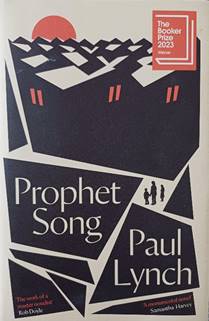
This is the second novel about people living in an authoritarian/totalitarian political system that I have recently read. The first one was Celeste Ng’s “Our Missing Hearts.” It is about a fictional USA in times of anti-Chinese racism (https://www.researchgate.net/publication/376303904_Celeste_Ng_2022_Our_Missing_Hearts_London_Abacus_Books_335_pp ). Paul Lynch’s novel—which won the Booker Prize 2023—turns Ireland into a fictional totalitarian state. Where Ng’s writing is direct and clear, a reviewer praised Lynch for his “beautiful, lyrical prose.” The following quote from p. 176 might serve as an example:
This feeling the attic does not belong to the house but exists in its own right, an anteroom of shadow and disorder as though the place were the house of memory itself, seeing before her the remnants of their younger selves, the self folded, packed into boxes, bagged and discarded, lost in the disarray of vanished and forgotten other selves, the dust laying itself down upon the years of their lives, the years of their lives slowly turning to dust, what will remain and how little can be known about who we were, in the closing of an eye we will all be gone.
I found this style somewhat distracting and, therefore, tried to just follow the flow of the story. Since I am an elderly German who cannot escape the memory of the Nazi regime (though I was born only in 1952), and who carries with him the experience of the German communist state (though I lived in West Germany), this story and its elements are predictable enough. So, on page 76, I thought I would quit. But since I had spent money for buying the book, I nevertheless continued, perhaps helped by the author’s fluent writing style, and my curiosity about how his imagination would fill the remaining pages. This approach brought me to the final chapter 8 (pp. 238-309), which I think is the strongest part of the book. Lynch succeeds to describe—step-by-step—the nightmarish almost total collapse of the protagonist’s remnants of an ordinary life, until she is left with the material and emotional ruins of her very recent past and only with a faint ray of hope for a peaceful future for herself, her baby, and her teenage daughter, Molly.
Lynch constructs his story by focusing on how an anti-regime family deals with a political system that has increasingly turned into a totalitarian monster. The family comprises Larry, his wife, Eilish, their teenage son, Mark, his younger siblings, Bailey and Molly, and the baby, Ben. Larry has a physical presence only at the beginning of the book. He is a Union organizer and wants to attend a big anti-regime rally. Eilish does not stop him from going out, though both know that the regime plans a crackdown. Indeed, thousands are arrested, and Larry disappears without any trace. Subsequently, Eilish tries to locate him with the help of sympathetic solicitors for a long time. Of course, these attempts are futile. Nevertheless, she remains hopeful, often speaking to herself as if she is speaking to Larry.
She struggles to explain what is going on to her four children. Moreover, she must manage the household and care for her father who suffers from dementia and lives in a different house. All this does not get easier when she is kicked out of her job by the ruling party. Things take a turn for the worse when a rebel army starts a civil war against the regime, and Mark joins them. Eilish’s and other houses are severely damaged when regime forces bomb the area where she lives. While she is more slightly wounded in the attack, Bailey has a shrapnel stuck in his skull. A nurse provides first aid and says that Eilish needs to bring her son to a hospital so that the shrapnel can be removed.
This is the situation that will lead us to chapter 8.
This book was shortlisted for the 2023 Booker Prize, which was won by Peter Lynch’s Prophet Song (see the separate note on that book). The paperback edition of Murray’s text is plastered with intrusive endorsements. Frankly, I strongly dislike this practice, although I do not mind a handful of them. Nevertheless, the book is well worth reading, despite its 643 pages. I could not make sense of the pages 185 to 285, so I just scanned them. When Murray writes about one of the characters, he omits full stops but keeps question and exclamation marks. Also, the beginning of a sentence is still capitalized. At first, I found this irritating, but I got used to it, though I still doubt that it is an effective stylistic device. As things move toward the climax of the book (pages 616 to 643), Murray chooses a format that I think conveys well the sense of accelerated urgency of the course of events.
You could read the book as a story about the dynamics within a family. And indeed it is about the Barnes family, which includes Dickie (husband), Imelda (wife), their teenage daughter Cassandra (“Cass”), and her younger brother “PJ.” They live in a small town in Ireland, not far from Dublin. Dickie has taken over his father Maurice’s successful car dealership and garage, and the family is well respected in the town. Despite this focus on one family, however, family dynamics are not at the heart of this novel. Rather, it consists mostly of separate portraits of its members and what happens to them. Among these portraits, Dickie is the main protagonist, portrayed as a perennial loser with a tendency to make reckless decisions or non-decisions. Cass is a rebellious teenager until she – temporarily – escapes the confines of the town by attending college in Dublin. For most of the book, PJ plays a rather limited role, while Imelda gets her fair share of attention as a poorly educated, consumerist housewife.
Everything could go on with the repetitive events of small-town life until an economic crisis strikes, destroying the economic foundation of the Barnes family’s fragile domestic balance. Money becomes scarce and conflicts increase. Imelda is forced to sell most of her possessions, while her relationship with Dickie becomes a one-sided screaming match. Dickie escapes by pursuing the construction of a “bunker,” a small cabin in the woods that is part of his property, pushed by his friend Victor.
One day, Maurice returns temporarily from his retirement home in Portugal, partly to see how bad things are with the company he founded. Accountants discover that a substantial amount of money has gone missing, and Dickie, as manager, is the only person who could have taken it. However, he shirks responsibility and avoids being confronted by his father, who soon has to return to Portugal. Why Dickie does not want to be questioned becomes clear when we learn that when he was at college in Dublin, he lived in a dormitory, essentially sharing accommodation with a man in an enthusiastic and emotionally satisfying homosexual relationship. He broke off this relationship when his brother, Frank, died in a car accident shortly before he was to marry Imelda. Although Dickie did not know her before, he took Frank’s place and married her. At their wedding, Imelda was unable to lift her veil because she had suffered a “bee sting” in one of her eyes. In fact, her father, who was pretending to drive her to the church, was so angry about her marrying Dickie that he punched her in the face with his fist.
Dickie’s homosexual past catches up with him when irregularities begin to occur in the repair department of his garage. A Polish mechanic seems to have removed converters from customers’ cars. Instead of firing him immediately, as the foreman urges, he keeps him on. Worse, he begins a wild four-week homosexual relationship with him. To make matters worse for Dickie, the mechanic has all of this on his cell phone and starts blackmailing him. The money missing from the company’s accounts was used to pay for his demands. Of course, Dickie is not willing to tell everyone what happened, either earlier in Dublin or now at the dealership. He wants to protect his family, or maybe even himself. He is too afraid of the shame and the consequences that would likely follow.
Maurice returned to Portugal to attend to other matters, and also because he was fed up with how his son avoided seeing him. Cass starts college in Dublin, paid for by Maurice, and things could have gone on like this forever. Until Dickie gets a message on his cell phone from the said mechanic demanding more money. While Victor strongly suggests that Dickie should just shoot him with the gun he bought, PJ realizes that his father had problems that he did not understand and therefore could not try to solve. So he travels to Dublin to ask Cass to come home and talk to Dickie, who has since decided to kill the blackmailer in the woods where he was supposed to hand over the money. Little do PJ and Cass know that the meeting place with the blackmailer is the very “bunker” they played in as kids. So, after arriving on the bus, they walk towards the “bunker,” even though it is already dark and raining heavily, making it hard for them to find their way. All the while, Dickie is lying in wait with the gun, ready to shoot the blackmailer as soon as he shows up.
The book ends with just two sentences on the last page: “It is for love. You are doing this for love.”
Like many people, I don’t have the time or inclination to scour the entire marketplace for fiction and non-fiction books, so I rely on recommendations from a variety of sources. One such trusted source is the Booker Prize, both the original and the one for translations. I had just received four books from the longlist of the International Booker Prize 2025. Yet, I was still stuck with one book from the shortlist of last year’s original Booker Prize, Rachel Kushner’s Creation Lake. Admittedly, I wasn’t very happy with that list. I started with Anne Michael’s Held but could not make enough sense of it to write a brief description. Perhaps, I will give it another try later. I moved on to Charlotte Wood’s Stone Yard Devotional, which turned out to be as low-key as her previous novel, The Weekend. I moved on to Samantha Harvey’s Orbital, which is a fine book, though some praise was more directed to its focus on our planet earth than its literary qualities. Then, I enjoyed Yael Van Der Wouden’s The Safekeep. Next on my list was Rachel Kushner’s Creation Lake. Her book took me a long time to finish, with several interruptions in which I pondered whether it was worth spending more time on reading it. The actual theme sounded promising enough: An American female undercover agent with an invented identity is tasked to infiltrate a French rural commune of people with an alternative worldview and an inclination to disrupt state projects by staging protests. Since a big state-sponsored project is underway concerning the creation of huge water basins that would have a serious impact on the local farmers, her job is to find out whether the members of this commune are planning any disruptive actions, whether it is an “insurrectionary group.” “The core of my assignment and duties had been to infiltrate and to monitor Pascal Balmy and the Moulinards for proof they had committed sabotage and were planning more of it” (p. 71). A hundred pages later, the narrating protagonist reiterates, “It was my job to find evidence that the Moulinards were a threat. Whether they were a serious threat was irrelevant. Either I would locate evidence, or I would locate a way to implicate them, so that police could raid this backwater and shut down their little commune” (p. 173). This may sound as if this book is a crime novel. It is not. Far from it. Rather, the novel leisurely flows along like a small river in rural France. Readers are treated to reading many hacked emails written by a former left-wing revolutionary who now lives in a cave, muses about the Neanderthals and cave paintings, and sends his missives to the group that “Sadie” is set to infiltrate, which she does on the pretext of translating writings of this group from French into English. It takes the author 139 pages for “Sadie’s” first meeting with the leader of the group, Pascal Balmy. Sixty pages later, on p. 197, she finally arrives on her field site and is shown around by Pascal. A further one hundred pages later, on p. 291, she reports to her “contacts” (who remain faceless but provide her with almost all the information that she needs for doing her job) that the group planned to disrupt an agricultural fair that would take place in two weeks’ time. “From there, things accelerated.” But even this “accelerated” process needs one hundred more pages, until Kushner lets the climax of the book happen like a scene from a slapstick comedy (p. 390). Slapstick or not, “Sadie” is very well paid for her job, buys herself a nice E-Class Mercedes, and drives it into retirement in a nice Spanish seaside resort.










 Books worth reading