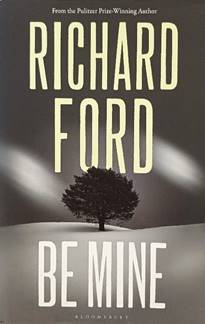
This is the latest installment in Richard Ford’s series about Frank Bascomb. In the opening chapter, Frank reflects about “Happiness.” He has become old by now. Fate has it that his son, Paul, who is 47, has become sick with Lou Gehrig’s disease, a terminal neurodegenerative disorder (ALS), for which he was treated at the Mayo Clinic in Rochester. The final chapter of this novel has the same title: “Happiness.” At that point, Frank’s son had already died, obviously from a different disease. He wonders whether by dying from that disease, his son was “‘lucky’” because with ALS, people “can live for years, lose all but their cognitive powers (which do not require muscles) then die as miserably and as surely as they would had they only lived a year—like my son” (p. 330).
In between these two chapters, Frank drives his son to the clinic where he was in an experimental treatment program. And he makes plans to organize a final trip with Paul to Mount Rushmore. Before this can start, Paul must still undergo some more proceedings at the Mayo Clinic, and Frank needs to find a camper big enough for both of them, and convenient for his son, who mostly moves around in a wheelchair. They find a large “Windbreaker” camper (Dodge 1500). “‘Awesome. Fucking awesome,’ Paul said … ‘It’s all built inside,’ he said, shuffling around below the open doorway. ‘Everything’s accessible. Space is the limiting factor—but not really.’ He flashed around at me again. ‘Don’t you think it’s fuckin’ great?’” (p. 90f.).
All the while, it is freezing winter, and the general atmosphere in this novel is of a gloomy America, nothing attractive or hopeful. Frank is also overcome by a certain longing for something more encouraging, sensory, conversational. As he puts it, “Spending most all of one’s waking hours with someone who’s dying—even if that someone is your son—should demand at least some attention to one’s own prerogatives” (p. 103, original italics). In his case, an opportunity arises (after they had arrived in Rochester shortly before Christmas) when Frank comes across an ad in a newspaper, “Vietnamese Massage Specialty. Women and Men Welcome. Locally Owned. Friendly. Reliable. Safe” (p. 105). That’s where he meets Betty Duong Tran, his “massage attendant.” She studies business at the University of Rochester and took $200, without Frank precisely knowing what he had to expect from his visit. It’s not a matter of sex, but of massage and conversation, food for the soul, not for satisfying one’s lust. He even took her out for dinner several times, hoping that she has some affection for him—besides the business aspect of their relationship. This went on for six-plus weeks, while his son attended activities at the Mayo Clinic.
On page 193, Frank and his son finalize the rental of the Windbreaker camper. They leave Frank’s car at the place, and their final joint trip to Mount Rushmore can begin. Father and son arrive there on page 313. Entrance is free since it is Valentine’s Day. Frank muses, “I cannot completely believe I’ve brought this unlikeliest of moments about, and can be here standing where I’m standing—with my son. How often do anyone’s best-laid plans work out? How often are promises kept and destinations achieved? I’ll tell you. Not very goddam often. Buddhists profess all is the journey. Abjure arrival. But what do they know? They’re hiding something, like all religions. And yet. Something about the four presidents-on-a-mountain seems not exactly right to me” (p. 321, original italics).
German original: Ruth Klüger. 1992. Weiter leben: Eine Jugend. 31. Auflage 2023. München: dtv. 284 pp.
When page numbers are given in the text below, they refer to the English translation of the text.
This book belongs to the genre of testimonies by Jewish people who survived the Holocaust in Auschwitz or another concentration camp. It is therefore similar to Margot Friedlander’s book “Try to Make Your Life.” A Jewish Girl in Hiding in Nazi Berlin. A Memoir. Both books were very successful in Germany. As of December 2023, Friedlander’s text has seen 16 printings, while Klüger’s book has been printed 31 times. Friedlander was captured in Berlin, Klüger in Vienna. Their writing styles are quite different. The former provides a straightforward narrative; the latter, who was a university professor of German literature in the United States, mixes her narrative with reflections and interpretations. Two other books in this series of book recommendations also deal with the Holocaust. Michael Frank’s One Hundred Saturdays tells the moving story of Stella Levi and the destruction of the Juderia of Rhodes, then part of Italy. Anne Berest’s The Postcard is a best-selling novel about her relatives, the Rabinovich family, who were sent from France to Auschwitz and murdered there.
Ruth Klüger (Americanized as Kluger) (1931 to 2020) was deported with her mother from Vienna to Theresienstadt, which was a ghetto, neither a labor nor an extermination camp. She stayed there from September 1942 to May 1944. It was only one month after her arrival in Auschwitz that her death seemed to be unavoidable. Yet, she got a chance of survival purely by chance, and with the help of a kind fellow prisoner who worked as a clerk for one of the two selecting SS officers. One day in June 1944, another “selection” was ordered for the transfer of prisoners from the extermination camp Auschwitz to the labor camp Birkenau. In this selection, prisoners who could work were separated from those who could not. At that time, Klüger was only 12 years old. But the minimum age for passing the selection was 15. As had to be expected, her mother passed, while her daughter, Ruth, was rejected. This would have meant death in the gas chambers. Her mother pleaded with her to try again, this time in the line leading to the second SS officer. And she should lie about her age. She tried. When she moved in the line, a young female prisoner-cum-clerk saw her, “she left her post, and almost within the hearing of her boss, she asked me quickly and quietly and with an unforgettable smile of her irregular teeth: ‘How old are you?’ ‘Thirteen,” I said, as planned. Fixing me intently, she whispered, ‘Tell him you are fifteen.’” She followed her advice. “‘She seems small,’ the master of life and death remarked. He sounded almost friendly, as if he was evaluating cows and calves. ‘But she is strong,’ the woman said, ‘look at the muscles in her legs. She can work.’ She didn’t know me, so why did she do it? He agreed—why not? She made a note of my number, and I had won an extension on life” (p. 125f.).
Klüger was in Christianstadt with other female prisoners from Auschwitz (there was a branch camp of the Groβ-Rosen concentration camp; after 1945, Polen acquired the town and called it Krzystkowice) when, in January 1945, the Russian forces were approaching. The camp was evacuated. The remaining prisoners were sent on one of the infamous “death marches.” One night in February, “we acted. On the second night we took off during the chaos of being herded into yet another container. It was again a village with barns…” (p. 155). “During the next minutes, as we six [she, her mother, three Czech woman, and Susi] ran down the street, away from the freezing, hungry prisoners and their enforced wait for shelter, we passed the barrier from the world of the camps into Germany … We were free—free to be hunted down if our luck should turn. But I remember the exuberance, the euphoria, of these moments” (p. 161).
The first American soldier they encountered was a disappointment, because he did not want to hear their story. He had heard too many of them already. “One thing, I figured, was certain: this war hadn’t been fought for our sake … The free world didn’t welcome us as brothers and sisters, long lost but found again, liberated from evil forces and now to be jubilantly included in the Family of Man. That was the picture my childish yearning had painted. In reality we were a burden, a social problem” (p. 180f.).
A novel that I briefly presented earlier (Adelle Waldman’s Help Wanted) was called a “workplace novel.” Samantha Harvey’s Orbital, in a sense, is also a workplace novel, though its choice of setting is even more unusual. Or has there been any previous novel on the international space station and its personnel? There are four astronauts on this station (Nell, Chie, Shaun, and Pietro) and two cosmonauts, as they are called in Russia (Anton and Roman). Obviously, this is not a novel about the group dynamics among the six of them. After all, they are highly specialized and trained individuals from Russia, the United States, Japan and Italy, who were chosen, among other criteria, for their balanced personalities, who had proven their capacity to live largely conflict free under cramped conditions in zero gravity. Harvey writes, “Don’t encroach, is their unspoken rule. Little enough space and privacy as it is, all of them stuck here together in each other’s pockets breathing each other’s overused air for months on end. Don’t cross the rubicon into one another’s internal lives” (p. 18).
Readers learn much about the conditions of life in such circumstances. For example, the astronauts/cosmonauts must exercise for two hours every morning, because without gravity that produced the need for having muscles, they will atrophy. They must not “give in to the seduction of weightlessness, nor her bones to birdies. Else that poor spacefarer will be in all kinds of trouble when she lands back on earth where legs, once more, are very much a thing. Without that hefting and sweating and pressing she would survive the blazing heat and tumble of her re-entry only to be pulled from her capsule and fold like a paper crane” (p. 12).
The real stars of the novel are the space station and, above all, the Earth. Harvey cannot get enough of writing which countries they have passed on their flight path (which is not really a flight but rather an endless falling of the space station, while the earth rotates beneath it), how the various landscapes look like from above, how the rising and setting of the sun above areas look like, or how typhoons build up their tremendously destructive momentum. Havey writes, “There are times when the rapidity of this passage across earth is enough to exhaust and bewilder. You leave one continent and are at the next within a quarter of an hour, and it’s hard sometimes to shake the sense of that vanished continent, it sits on your back, all the life that happens there which came and went. The continents pass by like fields and villages from the window of a train. Days and nights, seasons and stars, democracies and dictatorships. It’s only at night when you sleep that you’re relieved of this perpetual treadmill” (p. 125).
As in complex social endeavors more generally, the six of them are not really individuals. “They are specimens and the object of research who’ve forged the way for their own surpassing. … They are data. Above all else that. A means and not an end. … It was never really about them and it is not about them now—what they want, what they think, and what they believe. … it’s just about the future and the siren song of other worlds, some grand abstract dream of interplanetary life, of humanity uncoupled from its hobbled earth and set free; the conquest of the void. The six here might or might not dream this dream too, and it doesn’t matter if they dream it, it doesn’t matter, so long as they comply and play their parts. And this they do gladly day in and out” (p. 94f).
Seichō Matsumoto’s classic detective story was first published in 1958. Since the timetables of trains and planes play a very important part in this book, at the end, there is a note saying, “All train and plane times mentioned in this work are taken from the timetables of 1957, the year in which the incident took place” (p. 149). There are two maps in this book that enable readers to locate the numerous references to places stretching from one end of Japan (Fukuoka) to the other (Sapporo).
The ”incident” mentioned in the note happened on 21 January 1957, when a worker found the corpses of a man and a woman lying next to each other on a rock of Kashii beach of the Hakata Bay. The man was Kenichi Sayama, an assistant section chief in a ministry. The woman, in her job as a waitress, went by the name of Toki. The police found an empty orange juice bottle next to them. When the police doctor arrived, his assessment was clear: “Potassium cyanide, the pair of them. … They must have taken it with the orange juice.” Thus, this clearly seemed to be a double suicide by two lovers. Yet, old-hand inspector Jūtarō Torigai has suspicions and starts an investigation on his own. He does make some good progress, but as a local police officer, the range of what he can do is limited. On page 44, the direction of the investigation is fundamentally altered when Kiichi Mihara, in his early thirties, arrives on the scene. He is an inspector at the Tokyo Police. That they sent an inspector to talk with Torigai about what the local police had categorized as a love-related double suicide was because the ministry where the man who had died worked had been under investigation for corruption. To those investigating the corruption case, the death of the assistant section chief was a heavy blow since a man in his position would basically run the section and know best about everything that happened there. Therefore, he was both a crucial witness, and, perhaps, even a possible perpetrator. His death was very convenient for a good number of people in the ministry.
With Mihara entering the picture, the investigation moves from the local police in Fukuoka to the police in Tokyo. But Kiichi and Torigai remain in contact. In Tokyo, Inspector Kiichi is actively supported by his superior, Inspector Kasai. Very soon, a businessman dealing with machinery and with the ministry under investigation, Tatsuo Yasuda, becomes the center of suspicion. However, it appeared that he might have anticipated an investigation of his whereabouts during the “double suicide,” and meticulously constructed a complex web of movements that should prove beyond a reasonable doubt that he had nothing whatsoever to do with them, because he had not even been at the beach at the time the deaths occurred. Every time Mihara is excited because he thought he had cracked Yasuda’s alibi, new documentary evidence would show up to demonstrate that he was wrong. Torigai sends him a long letter urging him to persevere. He also offers some new theories about what could have happened. Yet, it seems as if Mihara runs against “An Unbreakable Barrier” (the title of part II, starting on p. 96).
The solution to the case is offered in the form of a long letter from Mihara to Torigai (pp. 130-149). Mihara reports what he has found out. Part of his findings confirm suspicions that Torigai had formulated in his earlier letter. The entire construction is watertight. But it has one fatal flaw: It is entirely circumstantial. There are no hard facts; there is no proof. Mihara and Torigai know exactly what has happened, but they cannot bring Yasuda to court. Nevertheless, the case can be closed, but in an unexpected way.
This novel brings us back to a theme that was raised in other entries to this list of recommended books: Nazi Germany and its mass murder of Europe’s Jewish population (Anne Berest, Michael Frank, Margot Friedlander, Ruth Kluger). The Safe Keep is set in the Netherlands of 1961. Isabel lives alone in a huge house. One of her brothers, Hendrik, lives in a same-sex relationship while another brother, Louis, is a womanizer. One day, Louis asks Isabel to let his then-girlfriend, Eva, live with her for a while because he had to be away on a business trip. Eva had been introduced to Henrik and Isabel earlier. Her impression of Isabel was unflattering: “Her face, I swear. Not even honey could sweeten that vinegar” (p. 209). Nevertheless, when staying with Isabel in the house, they engage in a passionate lesbian relationship. This part of the novel has some very inspiring, if I may say so, descriptions of the sexual side of their relationship. Eventually, however, Isabel kicks her out of the house because she discovers that the many items that had gone missing from the house (teaspoons, knives, letter opener; see the list from Eva’s diary on p. 216) were stolen by Eva.
In fact, they were not stolen. It was Eva’s way of trying to regain at least some of her family’s property from the house where she lived with her family when she was a small child. When Isabel’s family moved into the house, all the furniture of Eva’s family was still there. One family had moved out and left everything behind, while another family moved in and continued using everything that they found in the house. After she had kicked Eva out, Isabel tried to find out what all this meant. She visits her uncle Karel, who had acquired the house for her family to live in. On Isabel’s insistence, he says,
Yes, a family lived there. But they left. They did not pay their mortgage, they did not pay their taxes. This happens every day, people make gambles they cannot keep, people pack up and leave and they don’t take their plates and their spoons. Goodness! Do you understand? It happens every day. There is nothing untoward here, Isabel. It’s the law.” (p. 222)
In fact, there was very much “untoward” to the acquisition of the house. The Nazi army occupied the Netherlands in May 1940. Eva’s family was Jewish and had gone into hiding in Friesland, until Dutch neighbors informed the Germans of their existence.[1] In short, the mortgage for the house was not paid because Eva’s father was murdered in a Nazi concentration camp. Jewish people sent to these camps were only allowed to take with them what items they could carry, which accounts for the fact that the house was still full of their furniture and other belongings. Eva and her mother survived. After the war, they went to their home and demanded access but were brusquely refused. Eva experienced this as a child outside the entrance, Isabel, also still a child, experienced it in the house.
Isabel, in a mixture of feeling guilt, her loneliness, and her love for Eva finds out where she lives and visits her. Their encounter is unfavorable. Isabel returns to the house, and readers might wonder at this point how the author will close her novel. Of course, there could not be a Hollywood-style happy ending. Nevertheless, one day, there are bangs at the door. Isabel opens and sees Eva. Eva says, “I didn’t—think. God this was a bad idea, oh God I should—” (p. 252). Near the end of the novel, Eva says to Isabel “‘Look at me.’ Isabel looked at her. Eva kissed her. It was a hard press of lips over teeth, angry and then soft. Eva’s breath was hot. She was still weeping. ‘I’ll never leave,’ she said. It sounded like a promise. ‘If you are mine then I am yours. Do you understand? If I stay, if I’m yours then you must keep me, and I can never—’ The chair scraped and Eva was on her knees, too, and Isabel held Eva under the fall of her hair and they swayed” (p. 257). The next day, Isabel stood by the window while Eva came from behind. “She knew Eva was there, knew she had approached. She would never not know. She would never leave a room again and not leave half of her behind” (p. 258).
MHN
Nonthaburi, Thailand
30 December 2024
[1] The Dutch Central Archief Bijzondere Rechtspleging, or CADR, has recently begun the digital publication of lists of Dutch collaborators with the Nazi’s occupation forces. The list contains about 450,000 names (DER SPIEGEL, 2 January 2025).
This novel tells the story of three generations of an Afro-Brazilian family living on a plantation called Água Negra, located in the hinterland of Bahia, one of Brazil’s 26 states, located in its Northeast. Some of the black workers on the plantation refer to themselves as Quilombolas, a name for escaped slaves in colonial Brazil. Though they are free at the time the novel is set, their living conditions have changed very little. They are not paid for working the land of the Portuguese owner, and they are not allowed to build brick houses with tilted roofs. Rather, houses must be constructed by using only mud to prevent the workers from establishing a degree of permanence on the land and perhaps even claim the land they settle on as their own. For their livelihood, these black workers depend on the gardens that are attached to their huts. Thus, they are subsistence farmers who use most of their time to work on the owner’s plantation for free. In fact, many, especially of the older generation, even feel grateful to the owner that he has given them a piece of land on his plantation that they can use to sustain their livelihoods.
The book is divided into three parts with different narrators. Bibiana begins her story when she is seven years old. Her sister, Belonísia, is about one year younger. Fatefully, they discover an old suitcase under the bed of Grandma Donana. One day, when Donana is out, the sisters cannot suppress their curiosity and look through the contents of the suitcase. Among other things, they find a knife with a very shiny blade. For some reason, Bibiana takes the blade into her mouth and hurts her tongue. When Belonísia does the same, she cuts off most of her tongue. She is rushed to the hospital in town, but the doctors cannot reattach it. Thereby, Belonísia becomes mute for the rest of her life. Bibiana becomes her interpreter. It is only much later in the book that readers learn that Donana had stolen the knife from rich plantation owners and subsequently used it to kill the man with whom she had lived after she came home early one day to find him raping one of her daughters, Carmelita. That had been going on for one year, but the girl did not dare tell her mother.
The sisters’ father, Zeca Chapéu Grande, and their mother, Salustiana Nicolau, were both born of different other plantations. Zeca is a widely respected practitioner as House of Jarê, a set of syncretic religious and cultural traditions of Afro-Brazilians in a certain area of Bahia. He performs regular rituals at his house, which includes people getting possessed by spirits and dancing in trance to the sound of drums. Besides, he is an important traditional healer, both of physical and mental ailments. Mainly, however, he is a very skilled worker in the fields of the plantation. Salustiana, or Salu for short, followed her mother by becoming a midwife.
At some point in her narrative, Bebiana gets involved with her cousin, Severo. He has progressive ideas that he expresses with confidence. Severo persuades her to leave home in search of a better future elsewhere. In fact, she also aspires to go beyond working on the plantation for free. Reaching a decision is hard for her: “Watching my father and my mother grow old, working all day, every day, without rest, without any guarantee of comfort in their old age, that didn’t seem fair … But I couldn’t match Severo’s excitement about leaving home. I felt dejected and confused” (p. 77).
At one of the Jarê rituals, an unfamiliar encantada (spirit, supernatural deity) occurred. It possessed Dona Miúda and revealed itself as Santa Rita the Fisherwoman. Bibiana was grabbed by the possessed woman. She talked to her without the others being able to hear it. “…the exact phrase that persists in my memory, after the many blows I’ve suffered, is this: ‘From your movement shall come both your victory and your defeat’” (p. 79). Bibiana has almost decided against leaving with Severo, when she observed how the plantation manager, Sutério, humiliated her widely respected father. That changed her mind. Shortly afterwards, she is gone without even leaving a note for her parents.
With Bibiana gone, the story is now narrated by Belonísia. She tries to attend the newly established school, but it is hard because she cannot speak and is older than the other kids. More importantly, she is not drawn to learning, although she can already write and read better than her mother (her father is illiterate). She is drawn to working on the land. Zeca, her father, becomes her teacher about all things natural. One day, a new farmhand turns up at the plantation, Tobias, who is quite a bit older than Belonísia. He develops an interest in her, and eventually, he takes her to his house. She is shocked by its condition and of the interior. It is a pigsty. Belonísia describes her first sex with man as follows:
He laid me down on the bed and began kissing my neck, then lifted my dress. What happened next didn’t justify my fears. It was like cooking or sweeping the floor, just another chore, albeit an unfamiliar one. I was a woman living with a man now, so I understood this was something I’d have to do. As he entered and exited my body with a back-and-forth motion that brought farm animals to mind … I turned my head toward the window. (p. 115)
She never gets pregnant, and he gets more and more annoyed and abusive. As luck would have it, one day, he fell from his house and died, making Belonísia a lifelong widow.
After many years, Bibiana and Severo returned to the plantation. She had finished secondary school equivalency and studied teaching, earning a teacher certificate. He put his effort into trying to organize the farmworkers so that they could better pursue their interests. Zeca died of old age. Shortly afterwards, the owners sold the plantation. Anxiety grew about what this meant for the workers living on the land. Would the new owner just try to get rid of them, although they had lived on this land for generations, even having their own cemetery? Meanwhile, Severo had prepared a list of people who had signed up to establish a union. Severo and Bibiana already sat on their motorcycle to drive to town to have the notary register it. Bibiana got off the motorcycle to fetch another document from the house. Belonísia heard some popping sounds and ran out at the same time as Babiana: “Severo was lying on the ground. The dry earth at his feet had cracked open, and in that rift there flowed a river of blood” (p. 208). He had ben hit by eight bullets, and hardly anyone doubted that the new owner had hired gunmen to murder Severo to get rid of the single most important person opposing him.
The third part of the book starts with the spirit Santa Rita the Fisherwoman, who had been with the black workers since the time their ancestors were enslaved in Africa, speaking about the time that she had accompanied her human bodies. Some time after burying her husband, Babiana called a community meeting, observed by the supposed mastermind of the murder. She says,
Our people made their way to this plantation long ago. Each of us knows the story; it’s been repeated many times, a thousand times. Many of us, most of us, in fact, were born on this land. And what did our people find here? Nothing but hard work. Everything you see around you exists because of your hard work. … [We have been] Working just to be allowed to live on this land. The same slavery as before, but dressed up as freedom. What freedom is that? We can’t build brick houses, we can’t plant the crops we need. They take everything they can get from our labor. We work from Sunday to Sunday, without seeing a penny in return. … But we won’t stop fighting for our liberty, for our rights. The seed that Severo planted will not die. One of us is gone; he was my companion, the father of my children. But there are many more of us on this plantation. They plucked one fruit from the branch, but the tree remains. With roots too deep to be wrenched from the soil. (pp. 229-231)
One day, the new owner’s wife came running down the road from her house, screaming. He had been found lying in a pit. “Salomão’s body had been found nearly decapitated …” (p. 265). This followed a growing movement of disobedience from the workers, starting to build brick houses. Bibiana’s son was about to leave for the city to sit for the university entrance exam. Upon his departure, Belonísia remained standing at the door looking down the road the car had taken. “Bibiana was about to start grading students’ work, but she got up from the table and stood behind her. She wrapped her arms around her sister’s waist and nestled her face against her neck. Belonísia held her sister’s hands in hers. They both closed their eyes and shared the moment, surrendering to that gesture and experiencing something that might be called forgiveness” (p. 272).
The book ends with the following paragraph.
The jaguar fell into the pit but was holding on, clawing at the edge. The trap, hidden deep in the woods and covered by a mat woven of buriti fibers and dried cattails, filled it with terror. Some people swear that overseers used this kind of trap long ago to capture runaway slaves. The jaguar hit the bottom of the pit, its fangs driven into the ground. It wiped the dirt from its mouth. No, it was foolish to think the pit could hold the prey. But as it made to escape, a blade slashed its neck with a rage the beast had never before confronted.
On this land, it’s the strongest who survive. (p. 276).
Readers may be justified in assuming that the old encantada Santa Rita the Fisherwoman still wielded some power, after all.






 Books worth reading